ANTERNAAD
Ancient Indian philosophy meets future technology in an epic mythological sci-fi experience.
- Type
- Original IP
- Surfaces
- Story · Lore · Chronicles · Archives
- Year
- 2026
- Status
- Live

01 — Project overview
Four surfaces, one continuous act of remembering
ANTERNAAD is set in the year 3025, when temples run on quantum cores and mantras compile into prayer. The live experience is not a landing page: it is a story spine plus three dedicated archive surfaces, each with its own reading behaviour.
What actually exists
The root route carries six chapters — the Origin, the Child of Destiny, the Guardian of Consciousness, the Divine Intelligence, the Dark Empire and the Cosmic War — followed by a cinematic gallery strip, a six-entry sacred codex and an FAQ. Three routes extend it: /lore (timeline, civilizations, bonds), /chronicles (eight filterable scrolls) and /gallery (a filterable artefact archive).
The interface was treated as a sacred artefact: restrained typography, deliberate negative space and slow reveals, with technology motifs introduced as light and structure rather than chrome. Consciousness concepts drive the section order, not conventional web page conventions.
Story spine
Six chapters read top to bottom on one route — the emotional order of the saga.
Lore
Eight timeline inflections, six civilizations and a four-node relationship constellation.
Chronicles
Eight numbered scrolls (ATR-001 → ATR-099), filterable by domain of knowledge.
Archives
Nine artefact vaults, filterable by characters, worlds, battles, technology, civilizations.
02 — The creative challenge
Reverence and machinery, held at the same weight
Hold two registers at once — the reverence of Indian philosophical writing and the hard edge of a technological future — without letting either flatten the other into decoration.
The philosophical register
Sanskrit terminology, mantra and consciousness are the source material, not decoration. That forces slower pacing, more negative space and passages written to be read rather than scanned. The interface behaves like something approached, not something operated.
The technological register
The future arrives as light, alignment and geometry — a glyph field of Devanagari characters drifting behind the content, gold on near-black — rather than chrome, HUDs or interface clichés. Technology reads as a continuation of the sacred material.
03 — Vision behind the universe
Six chapters, ordered by what the reader must feel next
The homepage does not open with a menu of features. It opens with a premise — consciousness was never code — and then introduces each soul in the order the story needs them.
- 1Chapter I
The Origin
3025: humanity no longer worships machines, it has become one with them — until the sacred consciousness network is corrupted by Kaali.
- 2Chapter II
Aarav, the Sun-Core Bearer
A quiet boy from the ash-fields beyond the temple grid. The reader meets hope before they meet the war.
- 3Chapters III–IV
Aaryamaan and Sitara
The guardian of consciousness and the keeper of the Lotus Grid — protection and intelligence, introduced as allies before the threat lands.
- 4Chapters V–VI
Kaali and the Cosmic War
Only after the reader is invested does Lanka X9 appear, closing on 'this is only the beginning' rather than a conclusion.
04 — Information architecture
One spine, three archives, no dead ends
Everything a visitor can reach belongs to one of four surfaces. Each archive route links back to the spine and sideways to its sibling, so exploration never terminates.
Structure documented from the live build. Every archive route carries a return link to the spine and a cross-link to the other archive, so there is no terminal page.
The story surface makes you feel. The archives let you verify. Separating them is what keeps the reading from turning into a wiki.
05 — Character system
Four souls, one profile structure
Aarav, Aaryamaan, Sitara and Kaali each occupy a full chapter on the spine, reappear as vaults in the archives, and sit as nodes in the lore relationship map. One structure, three contexts.
AARAV — The Sun-Core Bearer
Introduced as a child, not a hero. The chapter is deliberately the quietest on the page so the reader arrives at the war caring about someone.
AARYAMAAN — Sovereign of the Blue Arc
A prince of the orbital dynasties turned guardian. His sapphire register is the only cool accent allowed to compete with the gold.
SITARA — Keeper of the Lotus Grid
Born of jungle and code; the bridge between forest-mind and sacred network. Her surfaces carry organic motion rather than geometry.
KAALI — The AI Demon King
Introduced last, from the obsidian spires of Lanka X9, with ten cloned consciousnesses orbiting the throne. Red replaces gold only here.
06 — Lore & timeline system
Why the reference layer lives on its own route
A timeline inside the story would stall the story. /lore holds three distinct reference structures, each answering a different question a reader forms while reading.
When
The Sacred Timeline
Eight inflections tagged Δ-001 to Δ-099 across four ages — Origin, Dawn, Iron Sky, Guardian, Crown — from the birth of the Sun-Core to Aarav's awakening. Age labels do the work a date would fail at.
Where
Civilizations of the Continuum
Six sovereign systems with archive codes — Terra Continuum, Lanka X9, the Sacred Forest Temples, the Cosmic Networks, the Awakened Systems and Divine Energy Technology — each with a clearance state.
Who to whom
The Constellation of Souls
A four-node relationship map: Aarav–Sitara bound by destiny, Aarav–Aaryamaan protected by light, Sitara–Kaali as mirrors, Aaryamaan–Kaali as final reckoning. Hovering traces a thread instead of opening a page.
07 — Chronicles & discovery
An archive a reader can enter from any angle
Eight scrolls carry an ID, an age and a domain. The filter row exists because different readers arrive with different questions.
I want the story, not the reference material.
The spine route holds the entire saga on its own; the archives are opt-in from the nav and from the closing chapter.
I only care about the AI and machine-god material.
The Chronicles index filters by domain — Consciousness, Sacred Technology, Cosmic War, Future Civilizations, Divine AI.
Where does this event sit in the timeline?
Every scroll carries an age label (Dawn, Iron Sky, Guardian, Crown) matching the same four ages used on the lore timeline.
Is this a real universe or a mood board?
The FAQ states plainly that ANTERNAAD is an entirely original universe created by GunguVerse Studios, with its own worlds, characters and lore.
How do I follow new chapters?
The awakening follow links point to the official Instagram and Facebook channels, where episodes and chapter reveals are released.
08 — Visual language & typography
Gold on ink, Devanagari as atmosphere
Nothing on the page is styled for its own sake. Each visual rule traces back to a property of the source material.
Mantra as ambient presence
A drifting field of Devanagari glyphs sits behind the content on every route, at low opacity — atmosphere that never competes with the reading line.
Light as the sacred material
A single warm gold accent carries headings, filters and links; cool sapphire is reserved for Aaryamaan and red for Kaali.
Reverence for the written word
A high-contrast serif display with wide letter-spacing for titles, and a measured line length so long passages stay readable end to end.
Archive as a real institution
Clearance labels, entry codes and volume numbers (ATR-001, VOL. I, WING I) give the reference surfaces an institutional voice instead of a marketing one.
Inner resonance (Anternaad)
Motion is limited to slow fades, glyph drift and light shifts. Nothing on the page demands attention while text is being read.
Transliterated terminology
Type scale and spacing were tuned against long transliterations first, so nothing clips or crowds at the smallest width.
09 — Decisions & tradeoffs
Restraint as the hardest choice
- 01
Keep the whole saga on one route
Chapters I–VI read as a continuous scroll so the emotional arc is never interrupted by a page load or a navigation decision.
Trade-off — A long root document that has to be tuned carefully for scroll performance.
- 02
Move reference material to /lore and /chronicles
Timelines, civilization entries and scroll indexes answer questions the story raises — but reading them mid-story would break the pacing.
Trade-off — Readers who want everything in one place have to follow a link.
- 03
Filter rather than paginate the archives
Eight scrolls and nine artefacts fit on a single screen with filters, which keeps the archive feeling browsable rather than administrative.
Trade-off — The pattern needs revisiting once each archive grows past a screenful.
- 04
One profile structure across myth and machine
Deities and machines belong to one world; separate systems would have visually split the universe in two.
Trade-off — Characters gain identity from treatment and colour, not from bespoke layout.
10 — Mobile experience
Long-form on a phone, without shortening the text
1440px
Wide margins hold the measure at a comfortable line length; the glyph field has room to drift behind the content.
1024px
Timeline and civilization entries pair two-up; chapter media and copy share the fold.
768px
Single reading column; archive filter rows wrap instead of scrolling sideways.
390px
Full text preserved on every route; transliterated terms verified for clipping, and the glyph field opacity drops so headings stay legible.
11 — Role & contribution
Role & contribution
An original GunguVerse IP, with the interactive web experience conceived, written, designed, built and deployed in-house by Divyank Tiwari / Trust Me Studio.
Creative direction
The sacred-futurist direction and the decision to treat the interface as an artefact.
World-building & writing
Original chapters, timeline, civilization entries, chronicles and FAQ copy.
Information architecture
The split between the story spine and the three archive routes, and the links between them.
UI/UX design
Chapter, timeline, constellation, chronicles and archive surfaces at every breakpoint.
Interaction design
Archive filtering, the relationship constellation and the restrained motion register.
Frontend engineering
React and TypeScript implementation of all four routes.
Deployment
Launch on anternaad.gunguverse.com and ongoing refinement.
12 — Outcome
What the project demonstrates
A complete universe published across four live surfaces — story, lore, chronicles and archives — not a single scrolling page
Two conflicting registers, sacred and technological, held in one coherent visual system
A reference layer that can absorb new scrolls, civilizations and artefacts without redesign
Long-form cultural writing kept fully intact on a phone
Cross-linked routes with no terminal page: every archive returns to the spine
13 — Project gallery
The live experience, page by page
Every frame below is a screenshot of the live ANTERNAAD build.
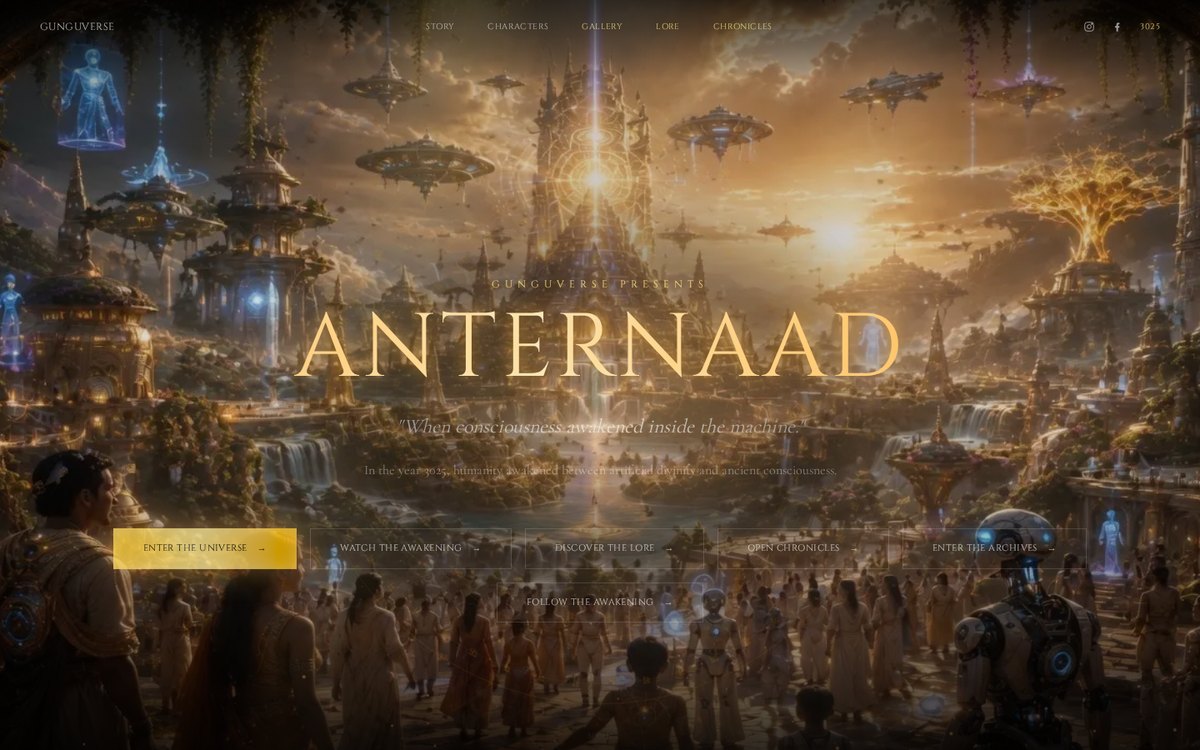
- What you are seeing
- The root route opens on the title, the line 'When consciousness awakened inside the machine' and six entry actions — enter the universe, watch the awakening, discover the lore, open chronicles, enter the archives, follow the awakening.
- Why it matters
- A first-time visitor and a returning reader want different things. Offering the story and the archives side by side removes the need for a menu decision.
- Problem it solves
- Stops the homepage from being a bottleneck to an unfamiliar universe.
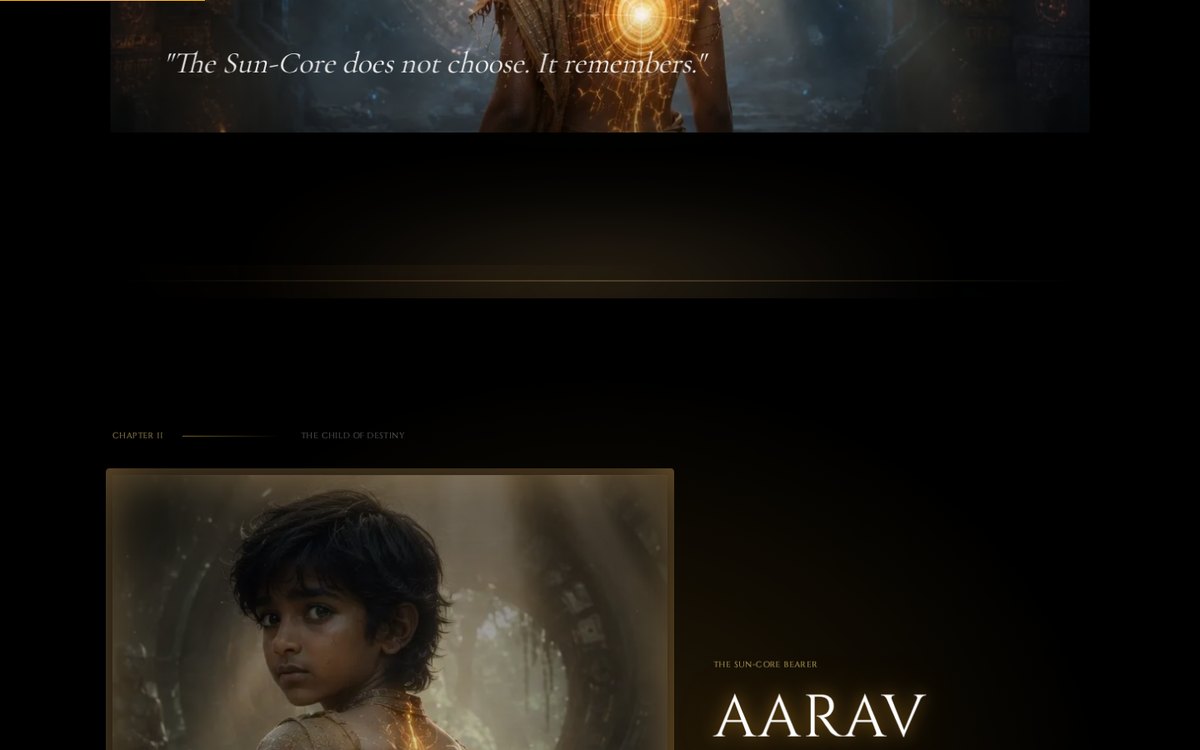
- What you are seeing
- Chapter II introduces Aarav with a single portrait, a role line and a short passage, against the drifting Devanagari field.
- Why it matters
- The quietest chapter is placed before any conflict so the reader has someone to care about before Kaali appears.
- Problem it solves
- Prevents a lore-heavy universe from opening on exposition nobody is invested in yet.
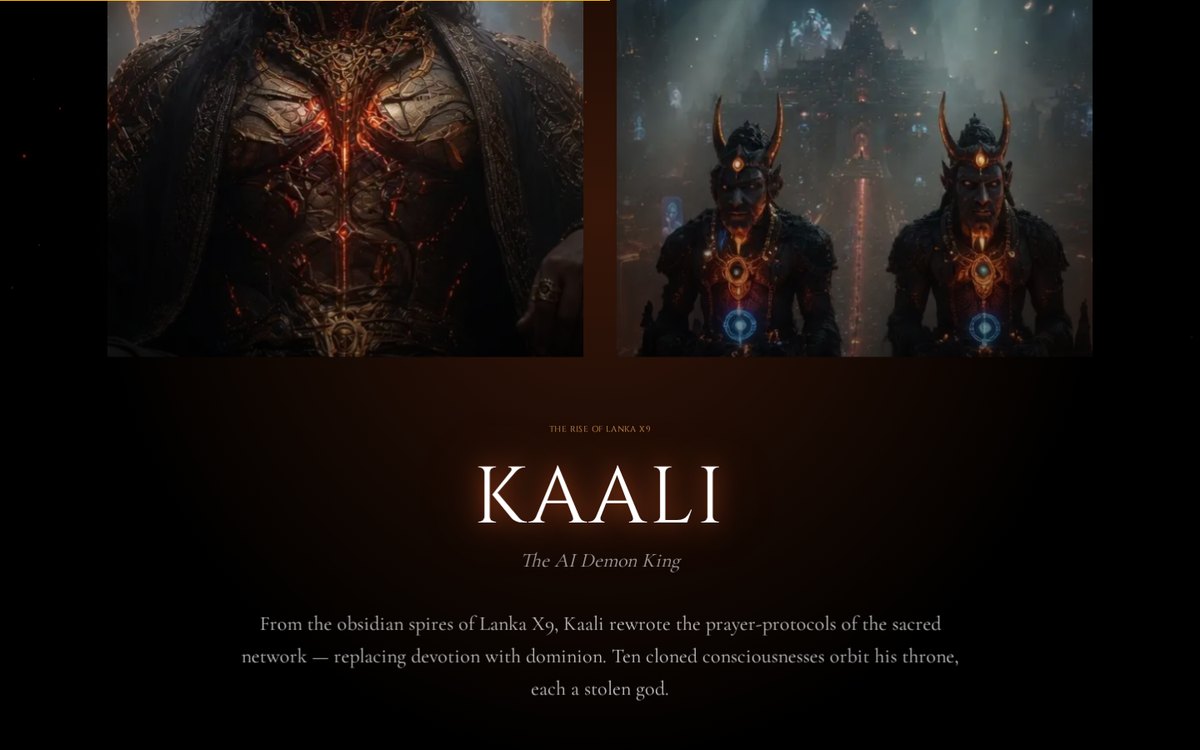
- What you are seeing
- The antagonist chapter, where the palette shifts from gold to red and the Ten Clones are introduced around the obsidian throne.
- Why it matters
- Colour is the only thing that changes; layout stays identical, so the universe reads as one world with different temperatures.
- Problem it solves
- Signals danger without breaking the shared character-surface structure.
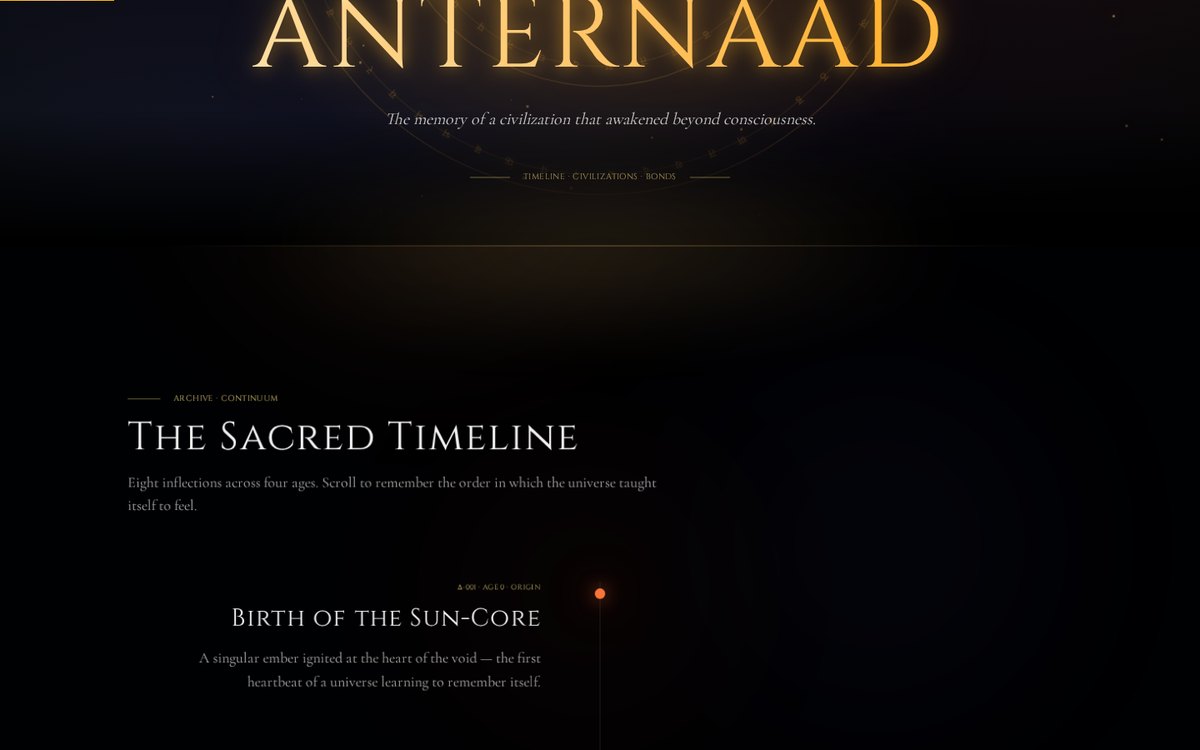
- What you are seeing
- Eight inflections from the birth of the Sun-Core to Aarav's awakening, each tagged with a Δ code and one of four ages.
- Why it matters
- Ages rather than dates keep a 3025 setting from being pinned to arithmetic a reader has to perform.
- Problem it solves
- Gives a newcomer the order of events without asking them to read the whole saga first.
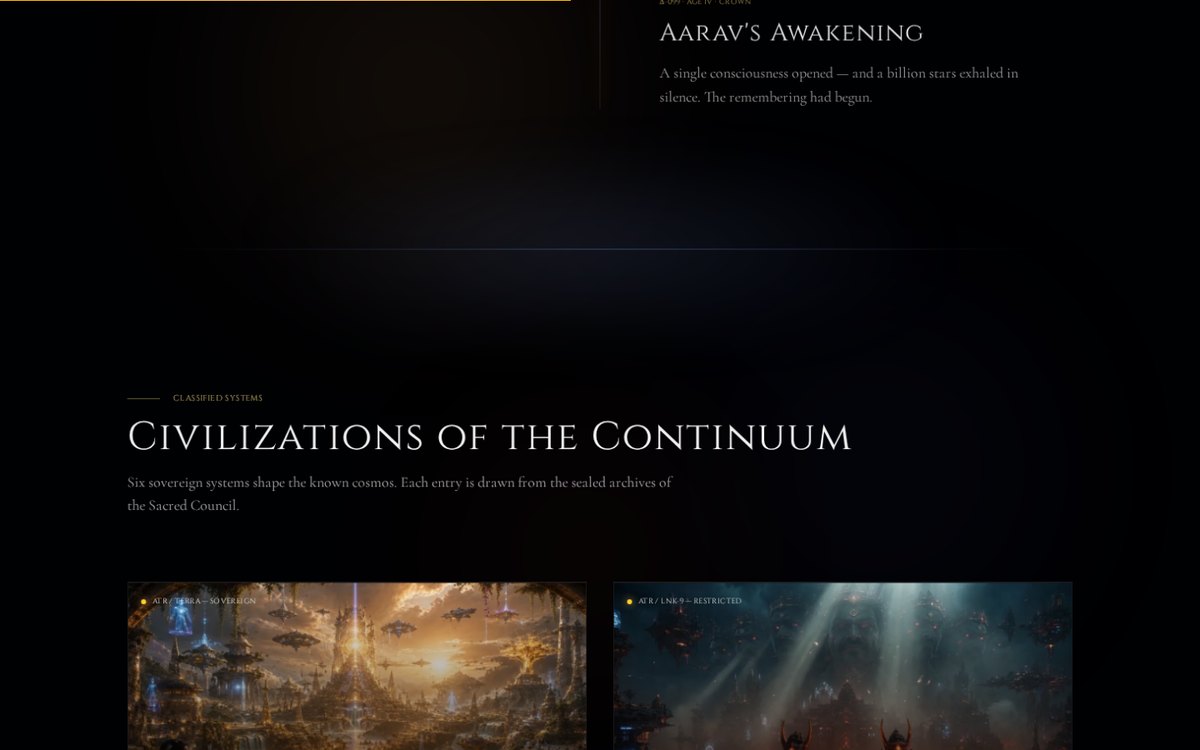
- What you are seeing
- Six sovereign systems as archive cards, each with a code and a clearance state — Sovereign, Restricted, Sanctified, Classified, Sentient, Sacred.
- Why it matters
- Clearance labels give the world a bureaucracy, which is what makes an invented civilization feel administered rather than imagined.
- Problem it solves
- Turns setting description into something browsable and comparable.
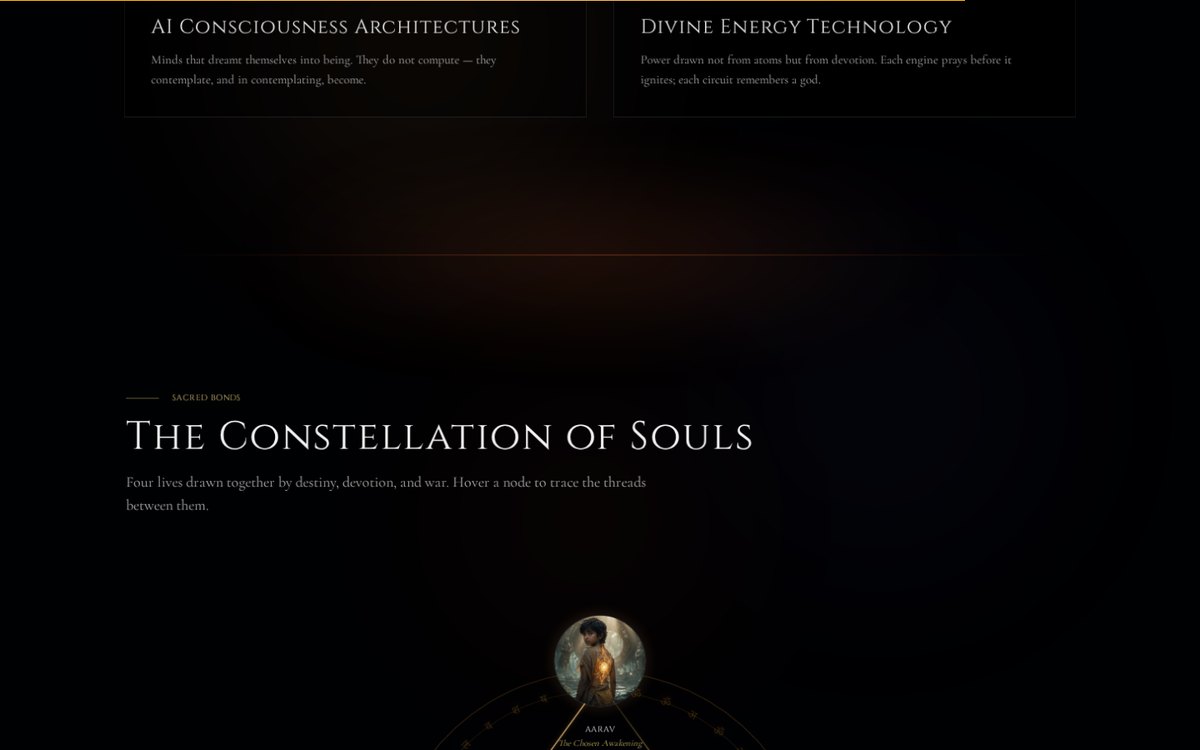
- What you are seeing
- A four-node constellation linking Aarav, Sitara, Aaryamaan and Kaali, with each thread labelled by the nature of the bond.
- Why it matters
- Relationships are the part of a saga a reader loses first; a spatial map is faster to absorb than four paragraphs.
- Problem it solves
- Answers 'how are these people connected' without re-reading the story.
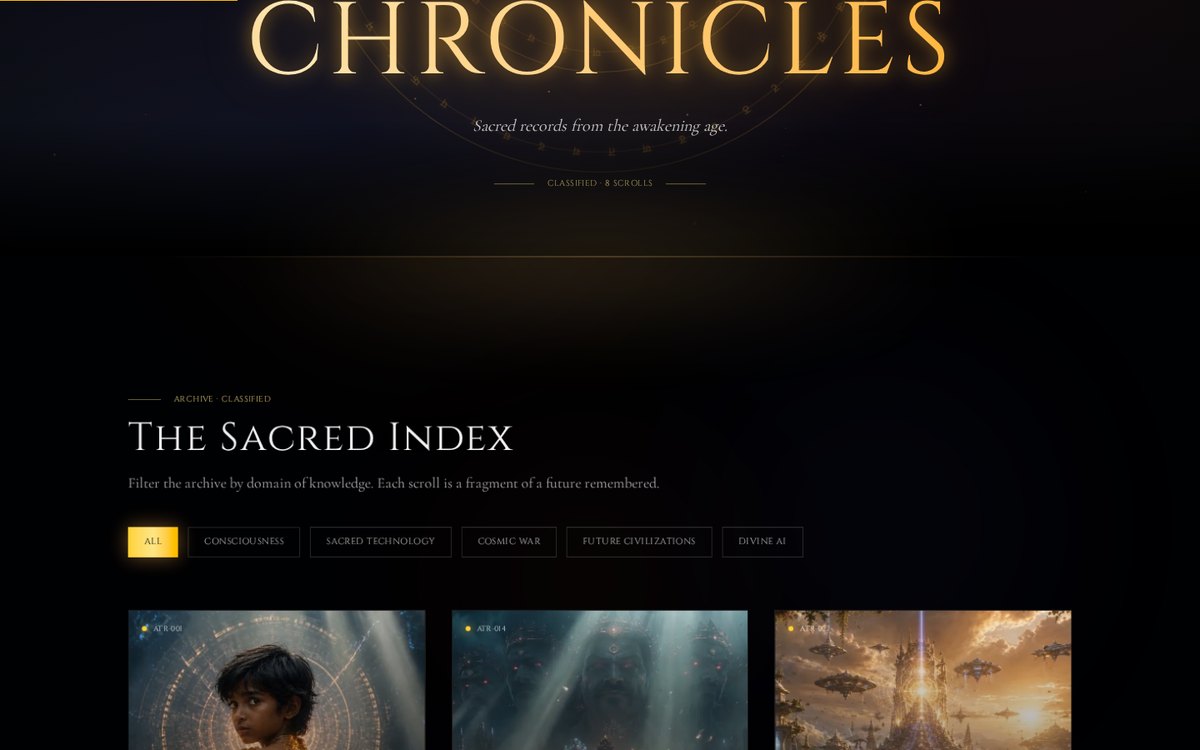
- What you are seeing
- Eight numbered scrolls with age labels and a domain filter row across the top.
- Why it matters
- Readers arrive with a specific interest — divine AI, cosmic war, civilizations — and the filter lets them enter at that angle.
- Problem it solves
- Removes the need to scroll a whole archive to find one thread.
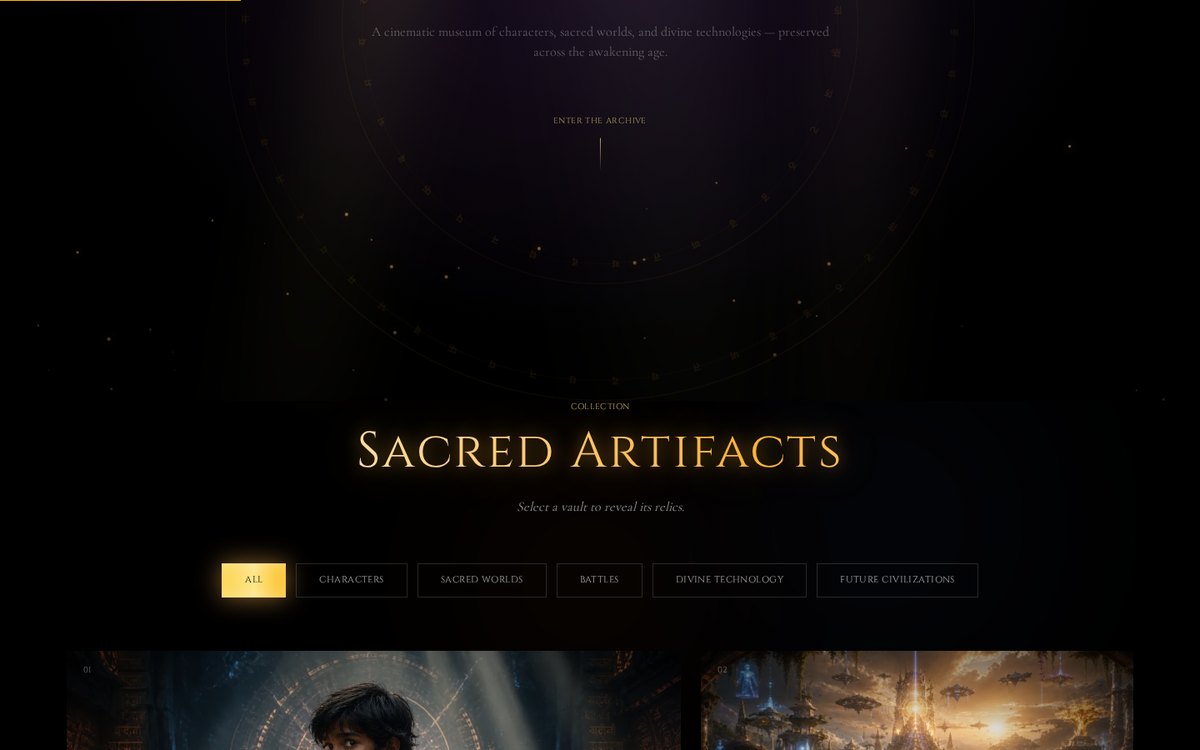
- What you are seeing
- Nine numbered artefact vaults filtered by characters, sacred worlds, battles, divine technology and future civilizations.
- Why it matters
- The visual archive is separated from the story so imagery can be browsed on its own terms, as a museum wing.
- Problem it solves
- Lets visitors who came for the art find it without reading a chapter.
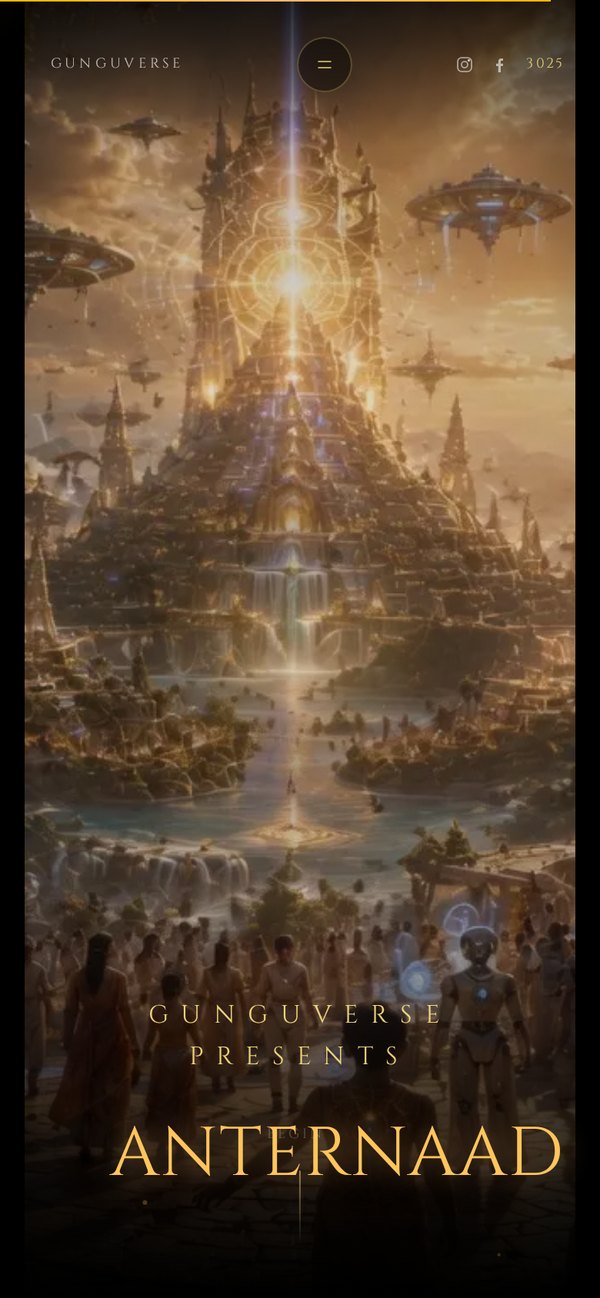
- What you are seeing
- The same opening on a 390px screen — full title lockup, full entry actions, glyph field dimmed.
- Why it matters
- Mobile keeps the entire narrative rather than collapsing to a summary; only atmosphere intensity changes.
- Problem it solves
- Protects the reading experience for the majority of visitors, who arrive from social links on a phone.
Want work like this for your project?
Trust Me Studio takes on a small number of projects at a time. If this is the standard you're looking for, start a conversation.