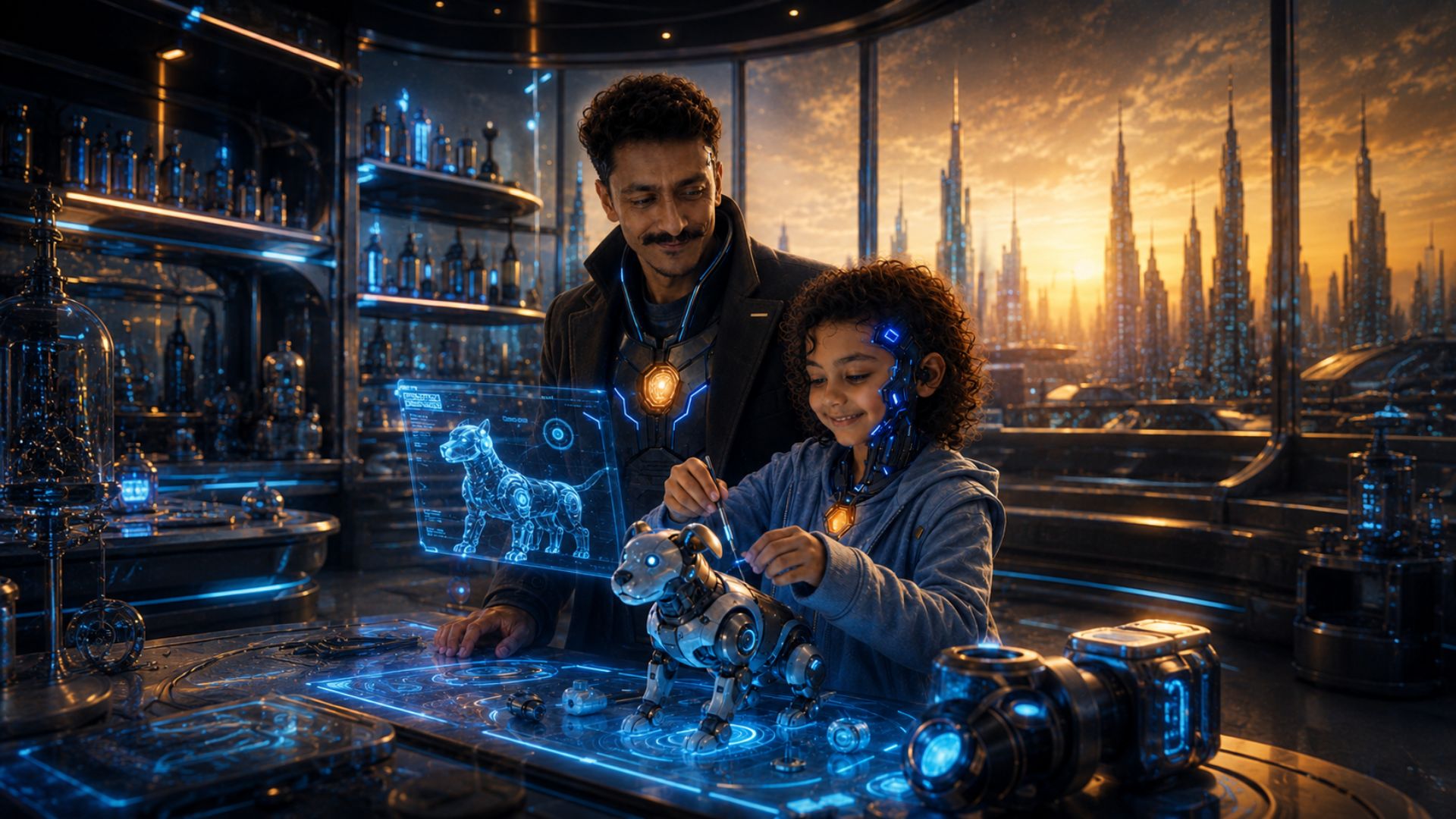
GUNGUVERSE
A family-friendly cinematic universe focused on imagination, wonder and hope.
- Type
- Original IP
- Role
- Parent universe & studio
- Year
- 2026
- Status
- Live
01 — Project overview
Nine routes, one connected creative ecosystem
GunguVerse is the parent universe and creative studio behind ANTERNAAD and Earth100000AD. The live build is a full site — universe, characters, world, downloads, books, founder, FAQ and contact — not a single landing page.
What actually exists
The home route runs from the universe premise through the family of characters, the world of tomorrow, five cinematic story scenes, six future project tracks, a downloads vault, the book library, a wallpaper wall and a collectibles horizon. Beyond it sit dedicated routes for characters, the world and its timeline, the library and Book I, the download vault, the founder and ecosystem page, an FAQ and a contact page.
Warmth was built through colour, character framing and pacing rather than cartoon cues. GunguVerse also acts as the anchor brand for the wider franchise, so its component language and navigation were designed to be inherited by sibling universes.
Two audiences, one site
Children and families arrive for Gungu, Baba, Rocket Raju and the wallpapers. Adults — collaborators, press and people evaluating the property — arrive to judge whether the universe is real. The founder route, the roadmap and the press contact exist for the second audience without disturbing the first.
02 — The creative challenge
Warm enough for a child, credible enough for a partner
Make a family-facing universe that reads as warm and imaginative to younger audiences while still looking credible to the adults, partners and collaborators who decide whether an IP is worth backing.
Tone
Warmth without cartoon cues
Tone is carried by palette, character scale, serif typography and pacing. No rounded cartoon conventions, because those would cost the property its credibility with adults.
Proof
A universe, not a mood board
Named books, dated scenes, a roadmap and a public ecosystem page are the evidence that this is an ongoing production rather than a concept.
Honesty
Coming soon, labelled as such
Collectibles, soundscapes, posters and lore packs are openly marked COMING SOON, and Book I scenes 02–05 are marked as unreleased.
03 — Information architecture
What lives on the home route, and what earns its own page
The home route is a guided tour of the universe. Anything a visitor might return to specifically — characters, the world, the library, the vault, the founder — gets its own route so it can be linked, shared and revisited.
Documented from the live build. The ecosystem block on the founder route is the only place the three universes are declared as one connected structure, which is why it carries the franchise hierarchy.
Children arrive through a character. Adults arrive through the founder page. Both are one click from the same universe.
04 — Discovery flow
Visitors arrive through characters, not menus
A menu asks a visitor to already know what they want. A character asks nothing. The entry model was inverted for that reason, and the rest of the site is arranged behind it.
- 1Arrive
A premise, then a family
The home route opens on the universe question, then introduces Gungu the dreamer and Baba the guide before anything is asked of the visitor.
- 2Wander
Five cinematic scenes
Chapters — Future Friends, First Robot, Starship Journey, Cyber Tigers, Future of Earth — each open a different part of the world.
- 3Take something
The vault
Free wallpapers, posters, coloring pages and quote cards in mobile, desktop, 4K and ultra-wide formats — a reason to return that costs the visitor nothing.
- 4Commit
Book I and the journey
The First Dream is readable now; scenes 02–05 are labelled coming soon, and Join the Journey is the single conversion action across every route.
05 — Character system
Named souls, and honest placeholders for the rest
The characters route carries five entries. Two are fully realised; three describe groups that are still being written — and say so.
Gungu — the dreamer
A child of tomorrow whose imagination shapes worlds. The emotional entry point for every younger visitor.
Baba — the keeper
Father, mentor and quiet keeper of wonder; the character that lets an adult reader into the story.
The quiet minds — AI beings
Synthetic souls born to wonder rather than to serve. The universe's position on technology, expressed as characters.
Future companions & children of tomorrow
Openly described as companions waiting in the wings of stories still being written, rather than presented as finished cast.
06 — World & timeline design
A future told in five gentle steps
The world route carries the lore, the civilization and a timeline of tomorrow — deliberately optimistic, because the universe begins where dystopia ends.
- 12030s
The Quiet Awakening
Humanity stops looking outward for answers and begins listening — to itself, its planet and the intelligence rising in its machines.
- 22050s
Cities of Light
Skylines breathe, buildings learn, and the line between architecture and nature dissolves.
- 32080s
The Companion Era
Synthetic minds become companions and teachers; children grow up with AI as a presence woven into wonder.
- 42120s
Worlds Beyond Worlds
Humanity steps off Earth — not to escape, but to extend the dream.
07 — Books & episodic storytelling
Release one scene, and show the five it belongs to
Book I — The First Dream — is published as Scene 01, with scenes 02 to 05 visible and labelled coming soon. The structure is the promise; the single released scene is the proof.
Is there anything to actually read?
Scene 01 is published in full on /books/first-dream, with the story text, a pull quote and a read action.
Is this going anywhere?
The scene rail shows all five scenes of Book I, with Scene 01 marked as live and the rest marked coming soon.
When does the next part arrive?
The route states that a new scene unlocks every week and names Scene 02 — The Galaxy Awakens — as next.
How do I not miss it?
Join the Journey is the single repeated action; the book page also offers wallpaper downloads and the Instagram reel for the same scene.
Is this a film, a game or a book?
The FAQ answers each of those questions directly rather than leaving the format ambiguous.
08 — The vault & audience loop
Give the universe away, and it travels
The downloads route exists because a family universe grows through what people keep. The Rocket Raju collection is built directly around where the audience already found the work.
Where they came from
Popular on Pinterest
Seven Rocket Raju adventures — Mission Begins, Lost in Space, Moon Mission Complete, Saving the Robot, Tiny Alien Friend, Ancient Space Temple, Guardian Robot — are grouped and labelled by the platform the audience discovered them on.
What they get
Formats, not just files
Wallpapers are offered for desktop, tablet and mobile, with view-full and download actions separated so nothing is downloaded blind.
What is honest
Six vault tracks marked coming soon
Posters, soundscapes, concept art, lore packs and the press kit are visible but openly unreleased, so the roadmap is legible without being overstated.
09 — Decisions & tradeoffs
Choices that keep a family universe credible
- 01
Warmth through colour and framing, not cartoon cues
Tone is carried by palette, character scale and pacing, so adults reading the page still take the property seriously.
Trade-off — Less instantly 'for kids' at a glance than a conventional children's brand.
- 02
Give the founder and ecosystem their own route
Partners and press need to see who is behind the universe, how the three properties relate, and what is scheduled. Putting that on the home route would have interrupted the story.
Trade-off — The franchise hierarchy is one click away rather than immediately visible.
- 03
Label everything unreleased
Coming-soon states on collectibles, vault tracks and book scenes keep the roadmap honest and make the released material more believable.
Trade-off — A visitor sees how much is still ahead.
- 04
Design system owned by the anchor
GunguVerse defines the component language that the sibling universes inherit, so the franchise stays coherent and a change lands everywhere.
Trade-off — Any system-level change has to be evaluated against three properties.
10 — Mobile experience
Characters have to survive every screen
1440px
Full-bleed character frames and the scene rail at full width, with room for the world around them.
1024px
Character and scene surfaces pair two-up without cropping faces; the timeline keeps its spine.
768px
Media stacks above copy; the nav collapses and the download grid drops to two columns.
390px
One character or scene per view, comfortable tap targets, no horizontal overflow, and Join the Journey always reachable.
11 — Role & contribution
Role & contribution
The anchor property of an original franchise — created, designed, built and deployed in-house by Divyank Tiwari.
Creative direction
The optimistic, family-facing but premium tone of the whole ecosystem.
World-building & characters
Original universe, cast, story scenes, the world timeline and Book I.
Franchise strategy
The anchor-and-siblings structure and the published roadmap across the three properties.
Information architecture
The split between the guided home route and the nine standalone routes.
UI/UX design
Character, world, library, vault, founder and contact surfaces.
Frontend engineering
React and TypeScript implementation across phone, tablet and desktop.
System maintenance
Franchise-wide design-system upkeep and deployment.
12 — Outcome
What the project demonstrates
A complete nine-route universe site — story, characters, world, library, vault, founder, FAQ and contact
One design system extended across three connected universes
Family-friendly positioning achieved without lowering visual standards
A published book structure with one released scene and an honest coming-soon rail
A downloads vault that turns audience goodwill into a reason to return
13 — Project gallery
The live experience, route by route
Every frame below is a screenshot of the live GunguVerse build.
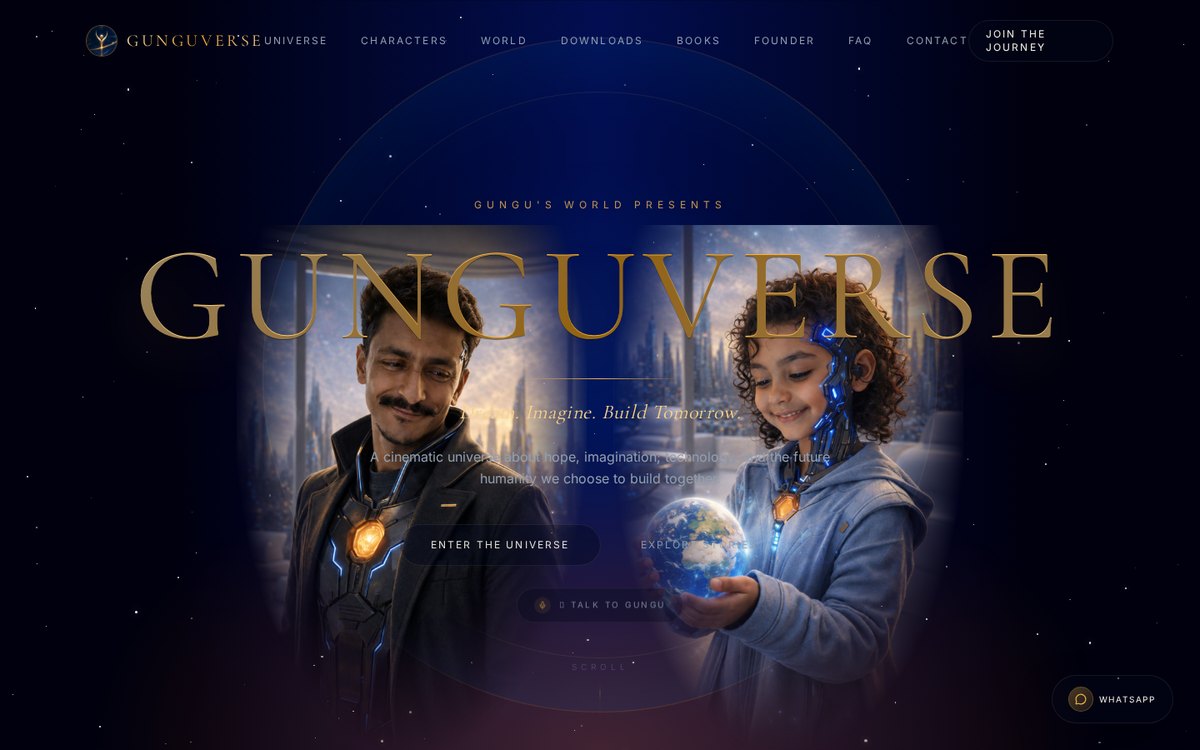
- What you are seeing
- The opening view: the wordmark over Gungu and Baba, the line 'Dream. Imagine. Build Tomorrow.' and three actions — enter the universe, explore stories, talk to Gungu.
- Why it matters
- The first thing on screen is people, not a value proposition, because a family universe is entered through characters.
- Problem it solves
- Gives a child and an adult the same, immediately understandable starting point.
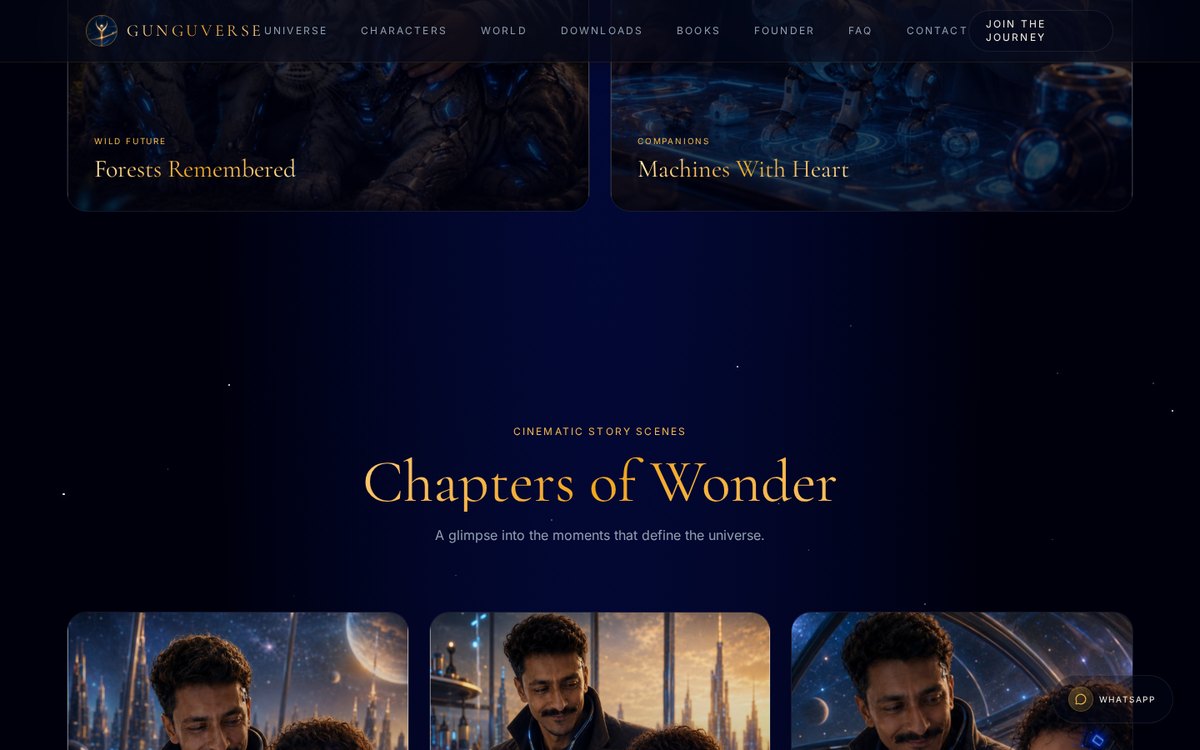
- What you are seeing
- Chapters of Wonder — five cinematic scenes, each with a chapter number, a title and a view-scene action.
- Why it matters
- Chapter numbering signals an ongoing production rather than a gallery of illustrations.
- Problem it solves
- Turns loose artwork into evidence of a structured universe.
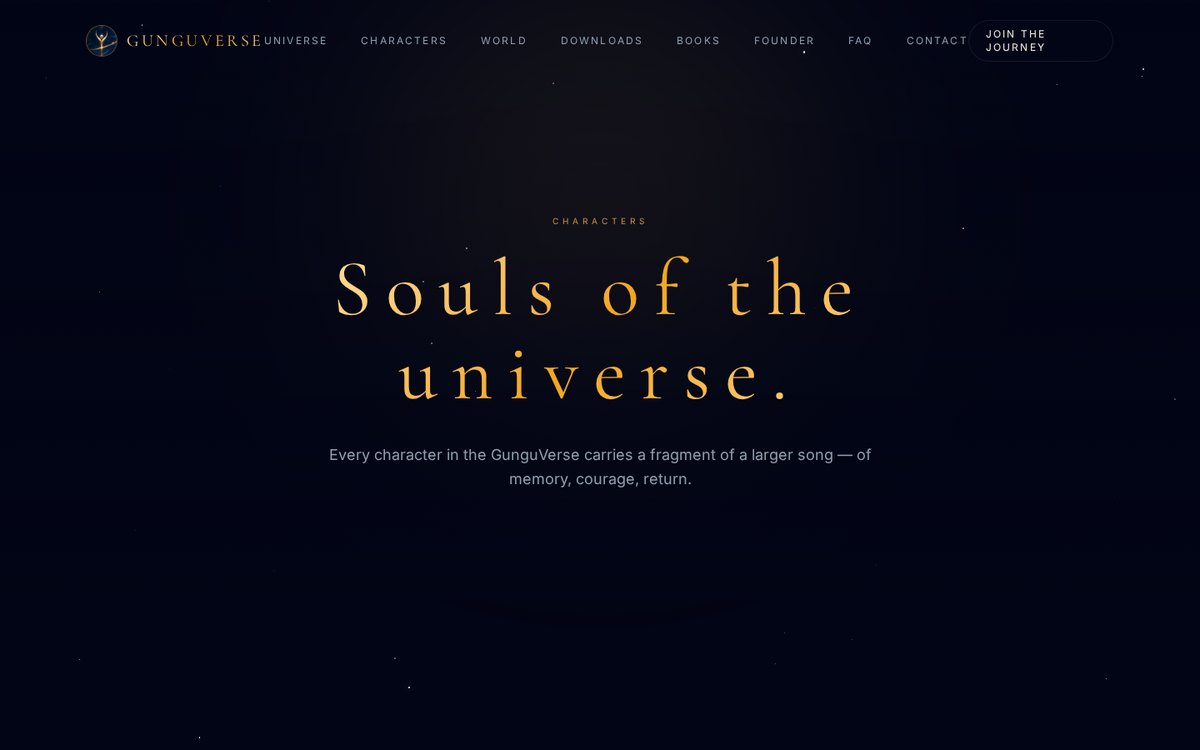
- What you are seeing
- Five entries: Gungu, Baba, future companions, the AI beings and the children of tomorrow.
- Why it matters
- Named characters and honestly-labelled future ones sit on the same page, so the cast reads as growing rather than thin.
- Problem it solves
- Avoids padding a young universe with invented characters.
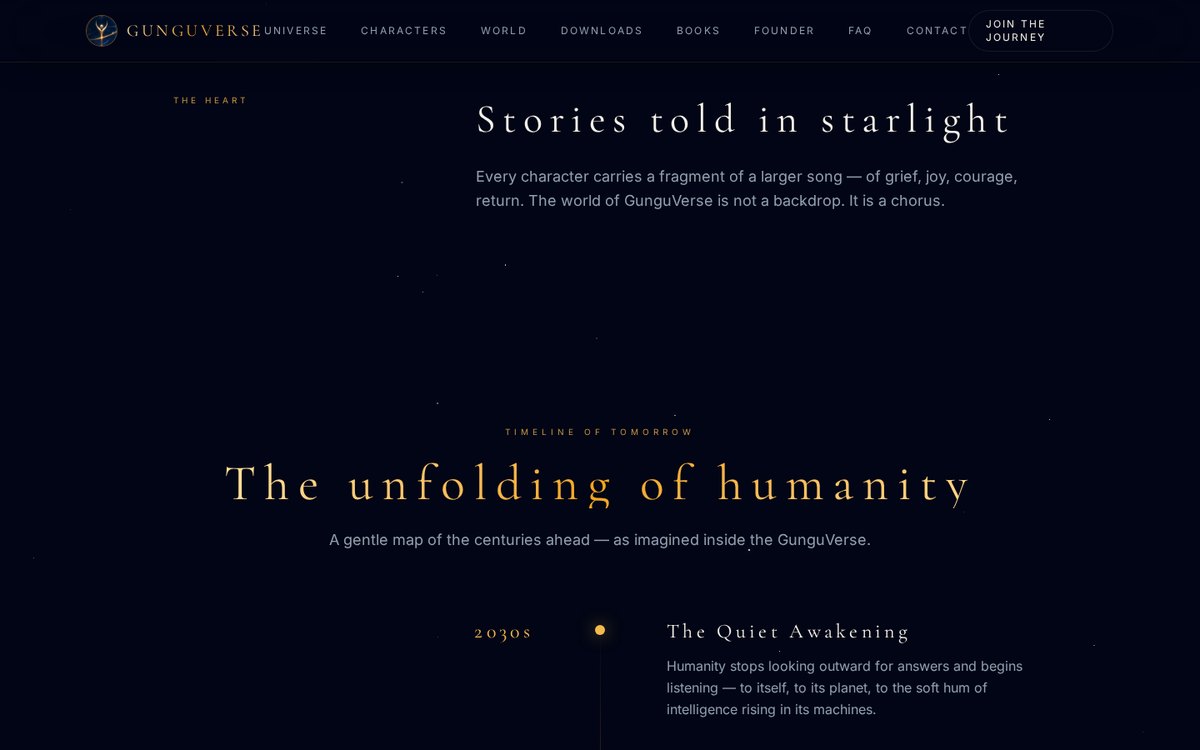
- What you are seeing
- A five-step timeline — the 2030s Quiet Awakening through to the GunguVerse itself.
- Why it matters
- A gentle, dated future is what distinguishes this universe from dystopian science fiction.
- Problem it solves
- Makes the world's optimism specific instead of a slogan.
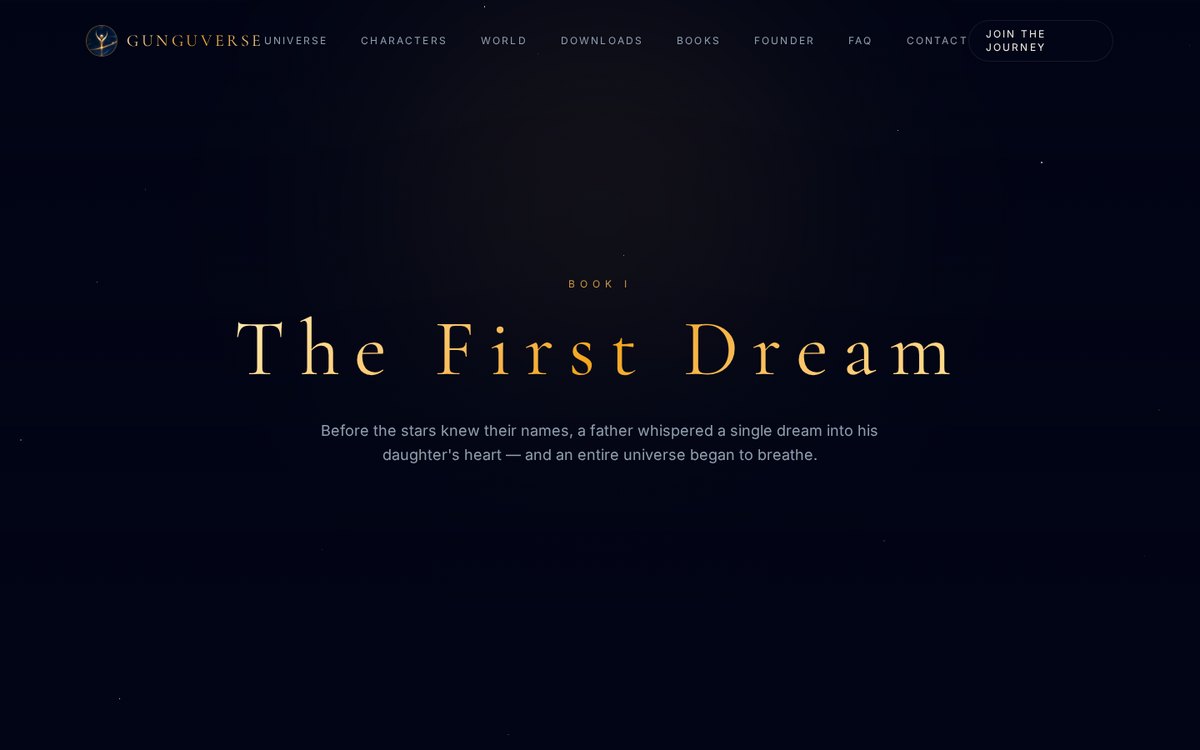
- What you are seeing
- Scene 01 published in full, with the story text, a pull quote and read, wallpaper and reel actions.
- Why it matters
- One finished, readable scene proves more than a shelf of announced titles.
- Problem it solves
- Gives a visitor something to actually consume on the first visit.
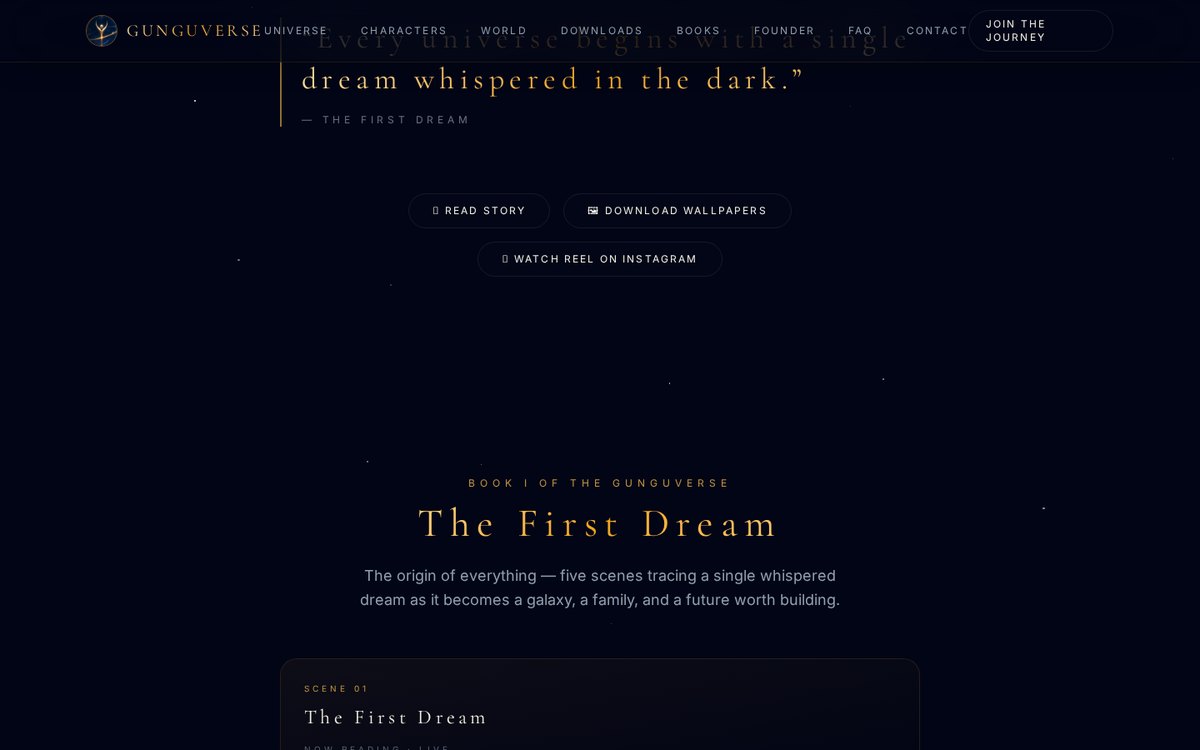
- What you are seeing
- All five scenes of Book I, with Scene 01 marked now reading and scenes 02–05 marked coming soon.
- Why it matters
- Showing the full structure makes the release cadence a promise the reader can hold the studio to.
- Problem it solves
- Converts a single published scene into a reason to return.
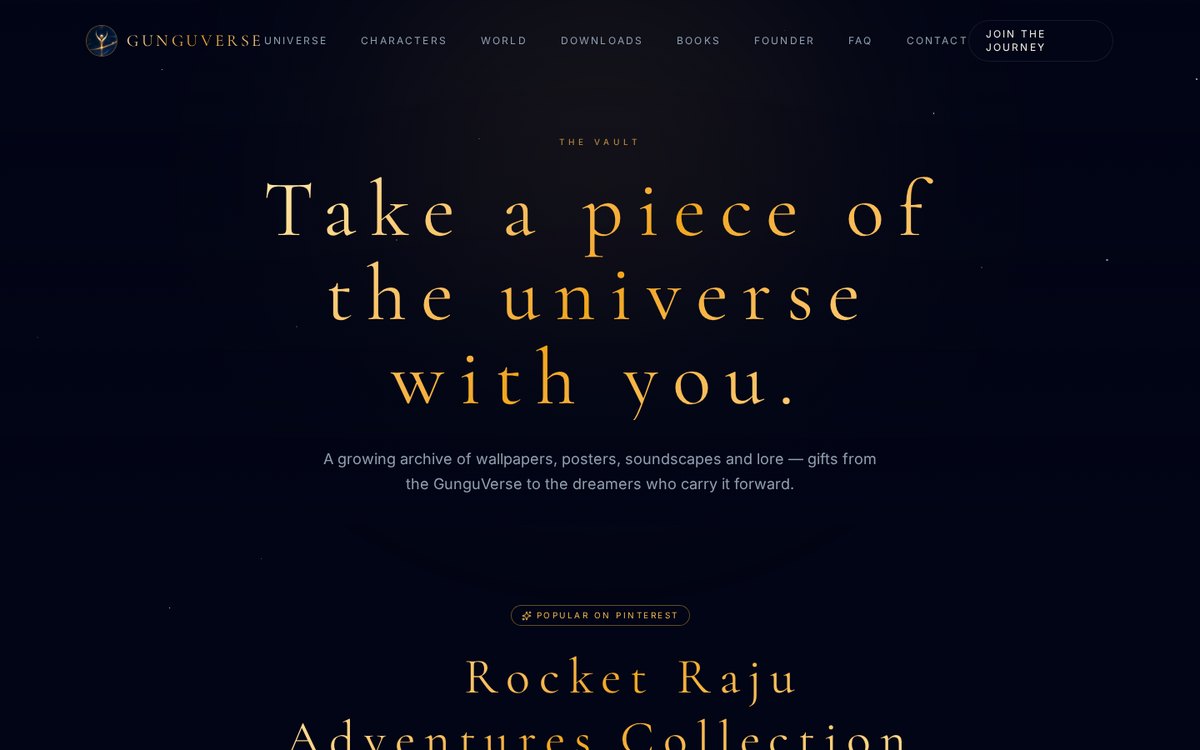
- What you are seeing
- The Rocket Raju adventure collection, grouped as 'popular on Pinterest', with separate view and download actions per wallpaper.
- Why it matters
- The vault is organised around where the audience actually discovered the work.
- Problem it solves
- Turns passive social discovery into a visit to the universe's own site.
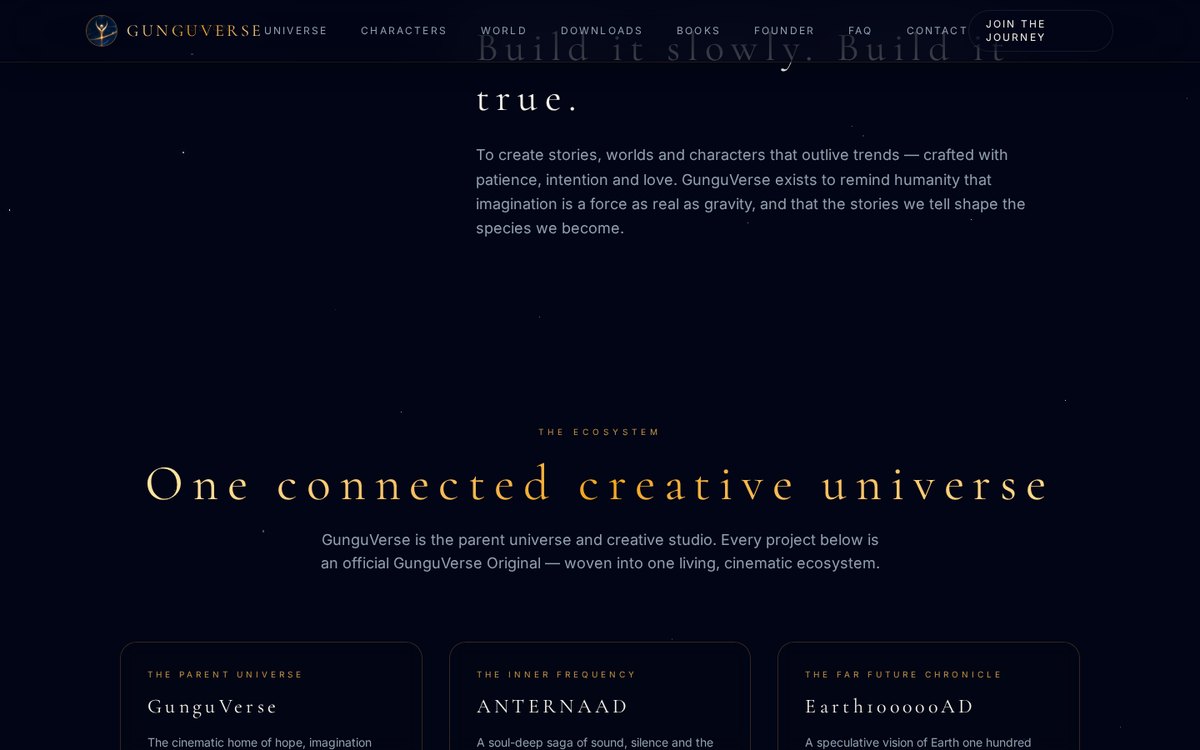
- What you are seeing
- GunguVerse declared as the parent universe, with ANTERNAAD and Earth100000AD as official GunguVerse Originals, followed by a dated roadmap.
- Why it matters
- This is the page that answers an adult's question — is this one person's page or a connected body of work?
- Problem it solves
- Makes the franchise structure verifiable instead of implied.
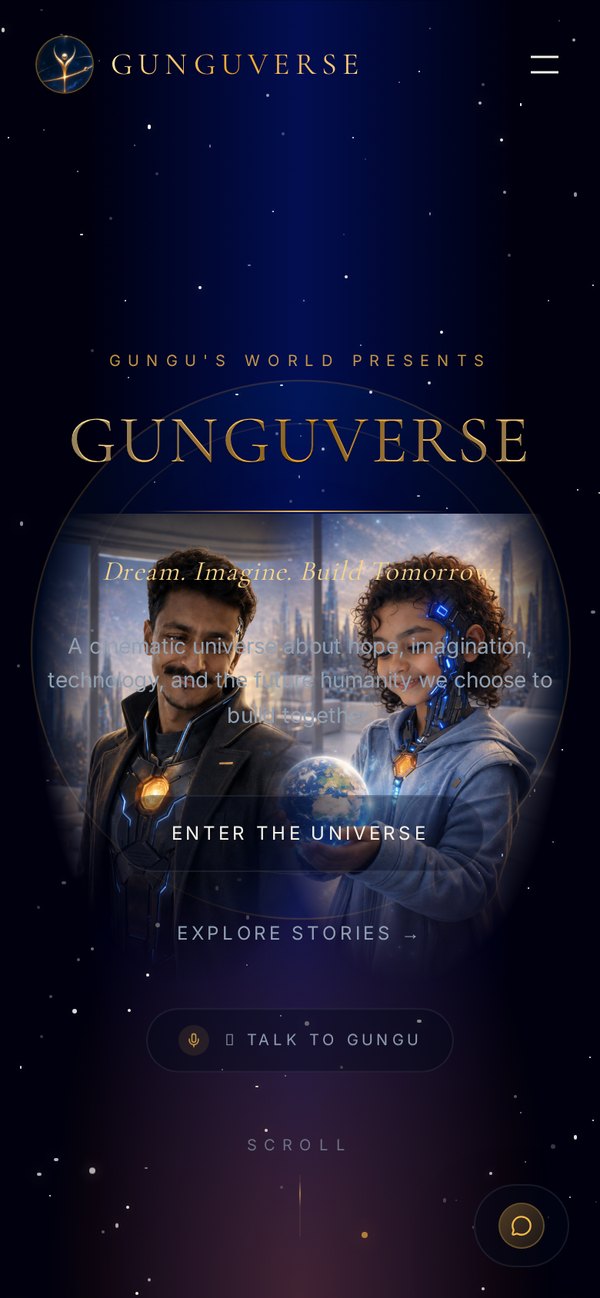
- What you are seeing
- The same hero on a 390px screen, with the wordmark, both characters and the primary actions intact.
- Why it matters
- Most family visitors arrive from a phone; the entry experience cannot be a reduced version.
- Problem it solves
- Keeps the character-first entry model working where most of the audience is.
Want work like this for your project?
Trust Me Studio takes on a small number of projects at a time. If this is the standard you're looking for, start a conversation.