EARTH100000AD
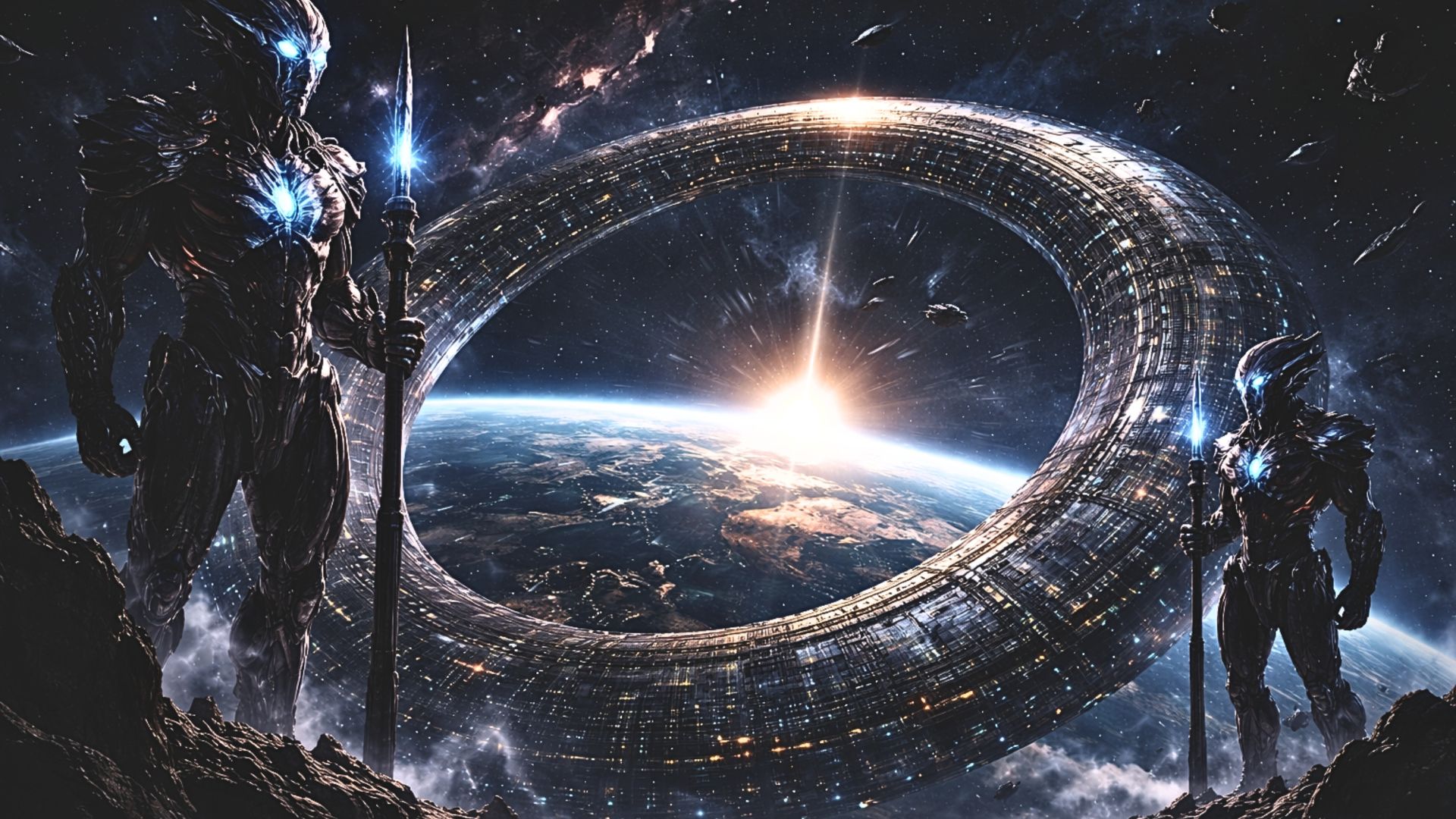
A cinematic sci-fi universe set 100,000 years in the future — humans, AI and beasts united against cosmic invaders.
- Type
- Original IP
- Model
- Interactive command console
- Year
- 2026
- Status
- Live
01 — Project overview
Not a story you read — a defence grid you are logged into
EARTH100000AD presents itself as the Earth Defense Command interface. The visitor is not an audience member; the build addresses them as a recruit with clearance, and every section is framed as a system they are operating.
What actually exists
Nine sections run inside one continuous console: the defence-grid hero, the Animal AI Parliament, the Seven Chakra System, the Alien Infiltration Test, Battle Zones, the Legends dossier archive, the Cinematic Legends Vault, Earth Defense Command, the Fall of Civilization archive and a classified training centre. A persistent status chrome — satellite link, corruption percentage, coordinates, AI narrator feed — sits above all of it.
The universe was written first, then translated into a reading architecture: a lore spine, a cast system and a scroll-driven visual language. Motion, typography and imagery were tuned to feature-film pacing so the story leads and the interface stays out of the way.
Persistent chrome
Satellite link, corruption level, coordinates and an AI narrator feed remain visible while scrolling.
Archives
Seven character dossiers, a media vault, ten timeline records and three battle theatres.
Interactive module
A clone scanner with a five-step documented process and a five-band result scale.
Orientation
A training centre that teaches the visitor how to read the rest of the interface.
02 — The creative challenge
A hundred thousand years of history, legible in seconds
Build an original science-fiction property that can hold an audience on the web — deep enough to reward reading, cinematic enough to feel like a screen experience, and structured so new chapters can be added without rebuilding the site.
Scale
The distance problem
100,000 AD is far enough away that nothing a visitor knows applies. The build solves it by anchoring on a familiar date — 2026 AD — and drawing the line forward.
Density
The lore-dump problem
Factions, species, machine empires and clone infiltration are a lot to absorb. Each is delivered as a card, a dossier or a record rather than as prose.
Participation
The passivity problem
Reading about a war creates distance. Casting the visitor as a recruit with clearance turns exposition into orientation, which they have a reason to finish.
03 — Information architecture
Nine systems, one console
Every section is a subsystem of the same fictional institution, numbered like a briefing. The order moves from threat, to factions, to identity, to archive, to training — the order an actual operator would be onboarded in.
Documented from the live build. Sections are numbered in-world (// SECTION 02 … // SECTION 09), which is what allows a single long route to read as a structured system instead of an endless page.
The interface never explains that this is a defence grid. It behaves like one, and lets the visitor work it out — which is why the world feels inhabited.
04 — Species, factions & civilizations
Four factions, seven legends, three theatres
The cast is not presented as a character list. It is presented three times, in three registers, for three different reasons.
- 1Choose a side
The Animal AI Parliament
Four factions at a war command table — Human Resistance, AI Mecha-Core, Cybernetic Wild and Shadow Clones — each with three named units beneath it.
- 2Read the file
Legends dossiers
Seven dossiers, from Lion Commander to Futuristic Human, each with a threat score, a faction, a status (active, hostile, dormant, ascended, unknown) and a filterable faction row.
- 3See the material
Cinematic Legends Vault
The same characters again as a media archive, filterable by faction and by media type — posters, reels, trailers, battle renders.
- 4Enter the war
Battle Zones
Three theatres — ocean, sky and mountain — each carrying coordinates, sector code, threat, enemy presence and war readiness.
05 — Timeline design
From 2026 AD to 100000 AD in ten records
The Fall of Civilization archive is the spine that makes the far future comprehensible. Each record carries a date, a threat value and an expandable body, so the timeline can be skimmed in ten seconds or read in ten minutes.
Present Day Earth
The anchor point — the only date the visitor already understands.
The First Signal
A transmission from deep space; the first deviation from the known world.
The Arrival
Motherships appear and the first planetary war begins.
The Clone Crisis
Clone technology spreads — the event the site's interactive scanner is built on.
The Great Collapse
Most civilizations destroyed; Earth enters a dark age.
The Animal Ascension
Evolution produces intelligent animal civilizations — the origin of the Cybernetic Wild.
The Machine Awakening
AI empires emerge and cybernetic species dominate territory.
The Cosmic War
The Dark Alien Emperor launches a galaxy-wide invasion.
The Final Defense Grid
Humanity and allied species build the shield network the site's chrome reports on.
Earth 100000 AD
The final age — the moment the visitor is standing in.
06 — Interactive experiences
The clone scanner, and why it is documented before it is used
The Alien Infiltration Test is the one place a visitor acts rather than reads. Because it asks for a camera or an image, the build explains the whole procedure in advance rather than after.
What is this actually going to do?
Module 01 of the training centre documents all five steps in order: capture, biometric scan, anomaly detection, probability analysis, threat classification.
What happens to my face image?
The orientation FAQ addresses the scan and storage question directly, in the same module as the instructions, before the scanner is reached.
What does the score mean?
Module 02 publishes a five-band scale from Verified Human (0–20%) to Alien Infiltration Detected (80–100%), so no result is ambiguous.
How do I read the rest of this site?
Module 03 is a database guide covering the character vault, lore files, timeline archive, threat database, AI assessment, media vault and relationship network.
Am I finished?
Module 05 closes orientation with a clearance-granted state and a single action back into Earth Defense Command.
07 — Visual language & immersion
Every ornament is a readout
The interface avoids decorative sci-fi. Each visual device carries fictional information, which is what keeps the console credible under scrutiny.
Chrome
Status that never leaves
Satellite link count, corruption percentage, coordinates and a live AI narrator line persist while scrolling — the world keeps running whether or not the visitor is reading.
Type
Monospaced authority
Wide-tracked technical lettering, section markers and clearance tags do the work a decorative sci-fi typeface would only imitate.
Colour
Cyan for systems, red for threat
Faction and threat states are colour-coded consistently across the parliament, the dossiers, the vault and the battle zones, so the code is learnable.
08 — Decisions & tradeoffs
What was chosen, and what it cost
- 01
Frame the whole site as an in-world system
Section numbers, clearance tiers and status readouts let exposition arrive as interface copy, which a visitor reads far more willingly than paragraphs of lore.
Trade-off — The visitor has to accept the conceit in the first few seconds or the page reads as noise.
- 02
Anchor the timeline on 2026 AD
Starting from the present gives the reader a foothold before the scale of 100,000 years is introduced.
Trade-off — The near-future records get more space than their narrative weight strictly deserves.
- 03
Publish the scanner procedure before the scanner
An interactive module that asks for a face image has to earn permission first; documenting the steps and the result bands is what makes participation reasonable.
Trade-off — An extra orientation section stands between the visitor and the interaction.
- 04
Present the cast three times in three registers
Faction table, dossier archive and media vault serve strategy, lore and art-seeking visitors respectively without forcing any of them through the others.
Trade-off — Character data has to stay consistent across three presentations.
09 — Mobile experience
A console that still reads as a console on a phone
1440px
Full command layout: chrome, globe, faction table and dossier grids at their intended density.
1024px
Dossier and vault grids drop to two-up; battle-zone stats stay inline with their theatre cards.
768px
Single column; filter rows wrap and the status chrome condenses to the essential readouts.
390px
Hero holds the planet and the primary scan action above the fold; every archive remains reachable with no horizontal scroll.
10 — Role & contribution
Role & contribution
An original GunguVerse IP, with the interactive web experience conceived, written, designed, built and deployed in-house by Divyank Tiwari / Trust Me Studio.
Creative direction
The command-console conceit and the decision to address the visitor as a recruit.
World-building & writing
Factions, dossiers, battle theatres, the ten-record timeline and all in-world interface copy.
Information architecture
The nine-section order, from threat to factions to participation to archive to training.
Interaction design
The clone scanner flow, archive filtering, expandable records and battle-zone war rooms.
UI/UX design
Console chrome, dossier and vault surfaces, and the training-centre modules.
Frontend engineering
React and TypeScript implementation of the full responsive build.
Deployment
Launch on earth100000ad.gunguverse.com and post-launch iteration.
11 — Outcome
What the project demonstrates
An original IP published as a navigable interactive system rather than a landing page
Nine in-world sections, seven character dossiers, ten timeline records and three battle theatres shipped as one coherent console
An interactive module whose process and result scale are documented before it is used
A cast presented in three registers — strategy, lore and media — without duplicating navigation
An architecture that can absorb new dossiers, theatres and records without redesign
12 — Project gallery
The live experience, section by section
Every frame below is a screenshot of the live EARTH100000AD build.
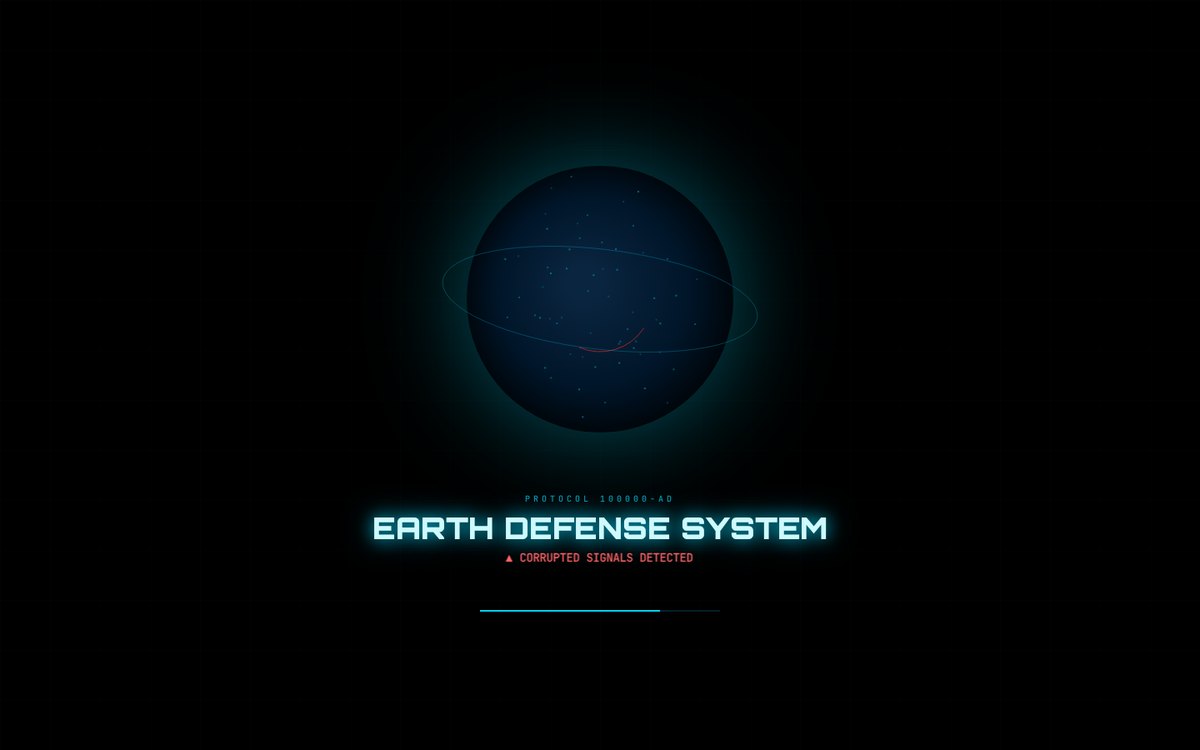
- What you are seeing
- The opening view: Earth Defense System chrome, live coordinates, corruption percentage, a 2026 → 100000 AD timeline strip and the primary action, Scan for Alien Clones.
- Why it matters
- The visitor is given a role and a single action in the first screen, instead of a value proposition.
- Problem it solves
- Removes the 'what am I looking at' pause that kills unfamiliar fictional worlds.
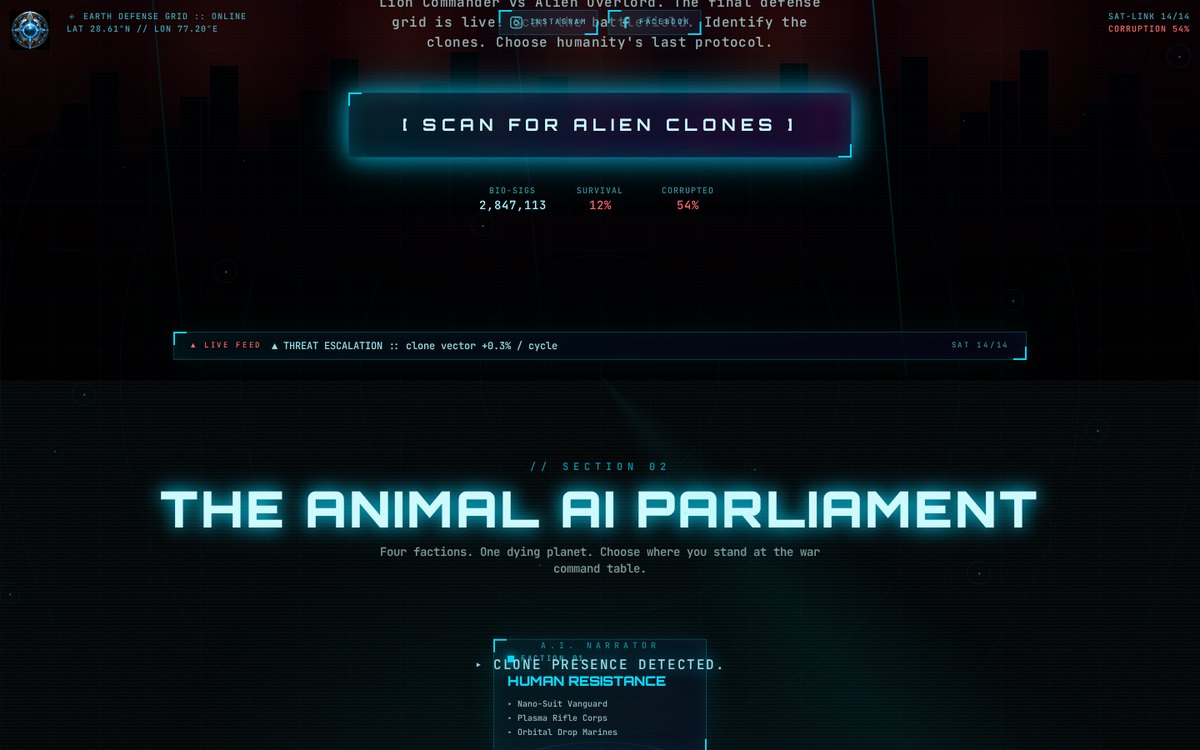
- What you are seeing
- Four factions arranged around a command core, each listing three named units.
- Why it matters
- A faction table communicates a whole power structure faster than any amount of narrative prose.
- Problem it solves
- Lets a visitor place every character they meet later into a side.
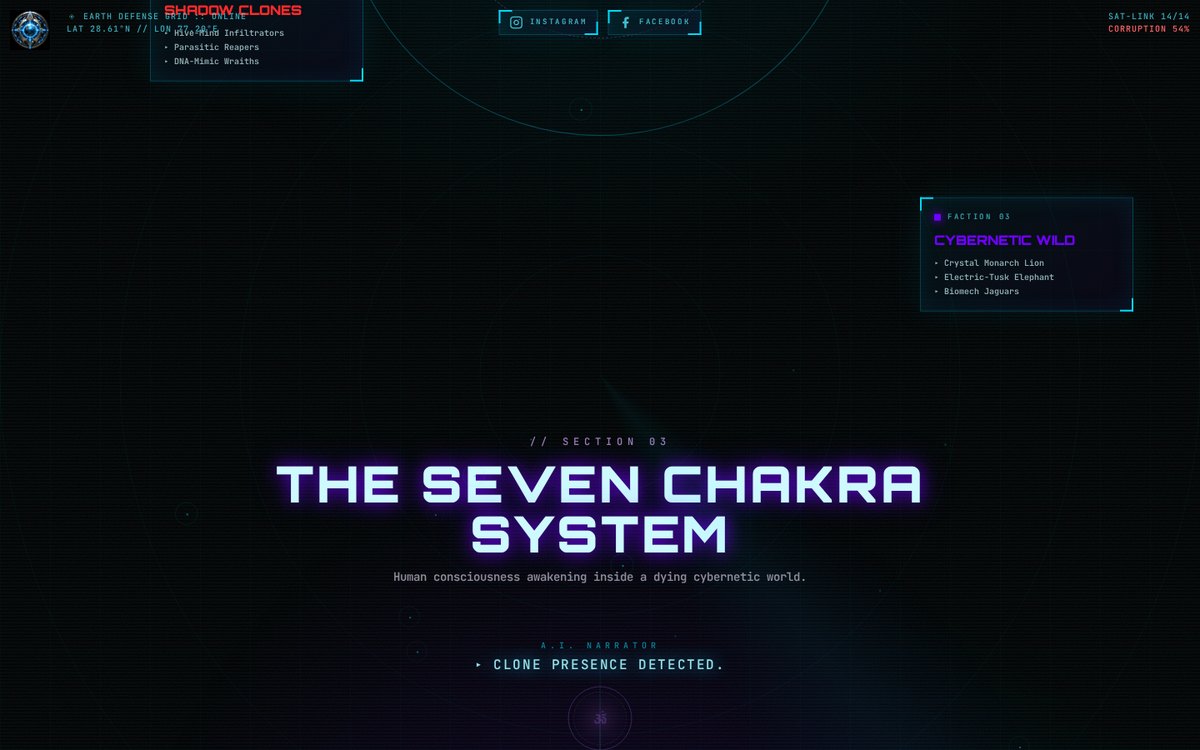
- What you are seeing
- Seven chakras with their Sanskrit names, seed syllables and frequencies, each reframed as a system of a dying cybernetic world.
- Why it matters
- It is the section that separates this universe from generic sci-fi — human consciousness treated as infrastructure.
- Problem it solves
- Gives the world a philosophy, not just a weapons list.
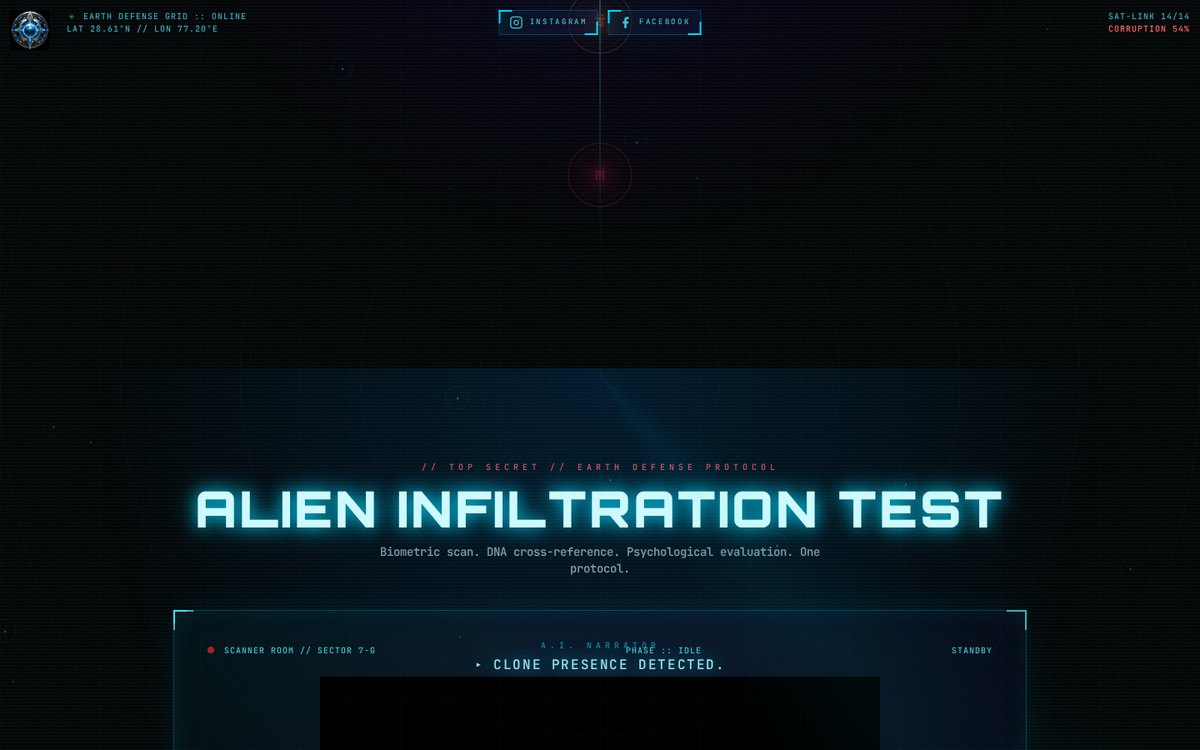
- What you are seeing
- The scanner room interface with phase state, camera standby and an Initiate Scan action.
- Why it matters
- One interactive moment converts a reader into a participant, which is what makes the world memorable.
- Problem it solves
- Breaks the passivity of a long scrolling narrative.
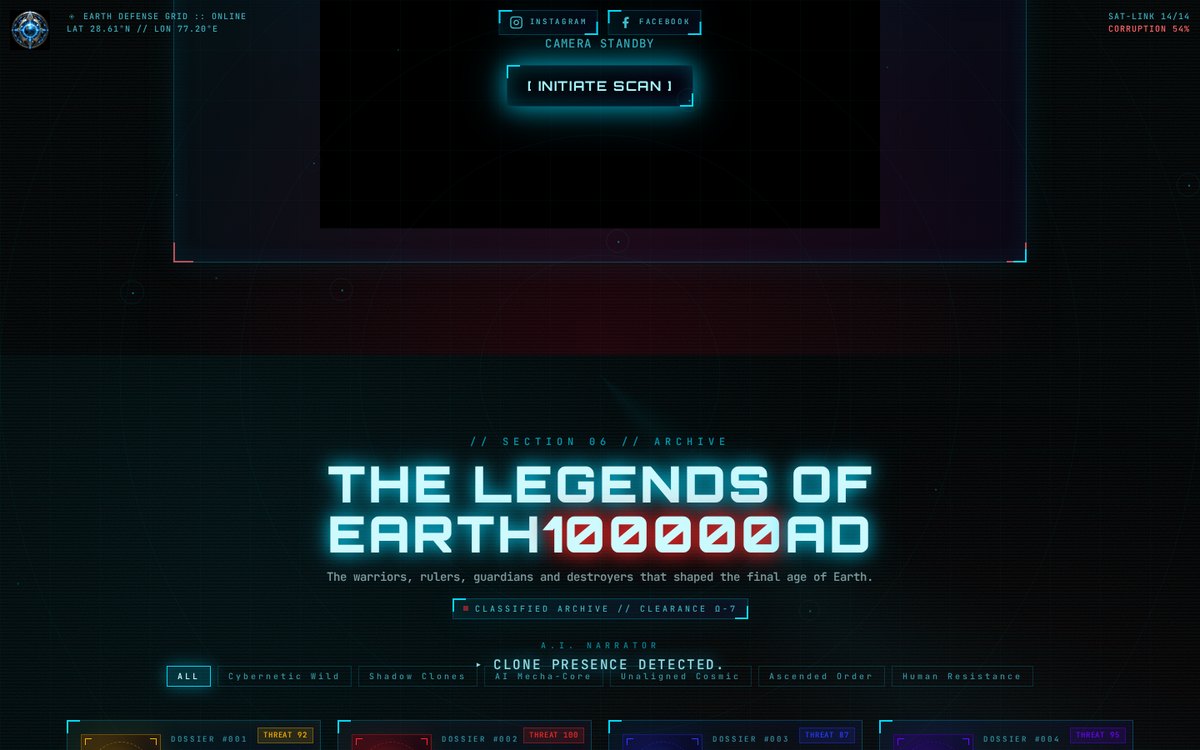
- What you are seeing
- Seven numbered dossiers with threat scores, faction tags and status states, above a faction filter row.
- Why it matters
- Threat and status turn a character list into a comparable dataset the visitor can reason about.
- Problem it solves
- Makes a large cast browsable rather than overwhelming.
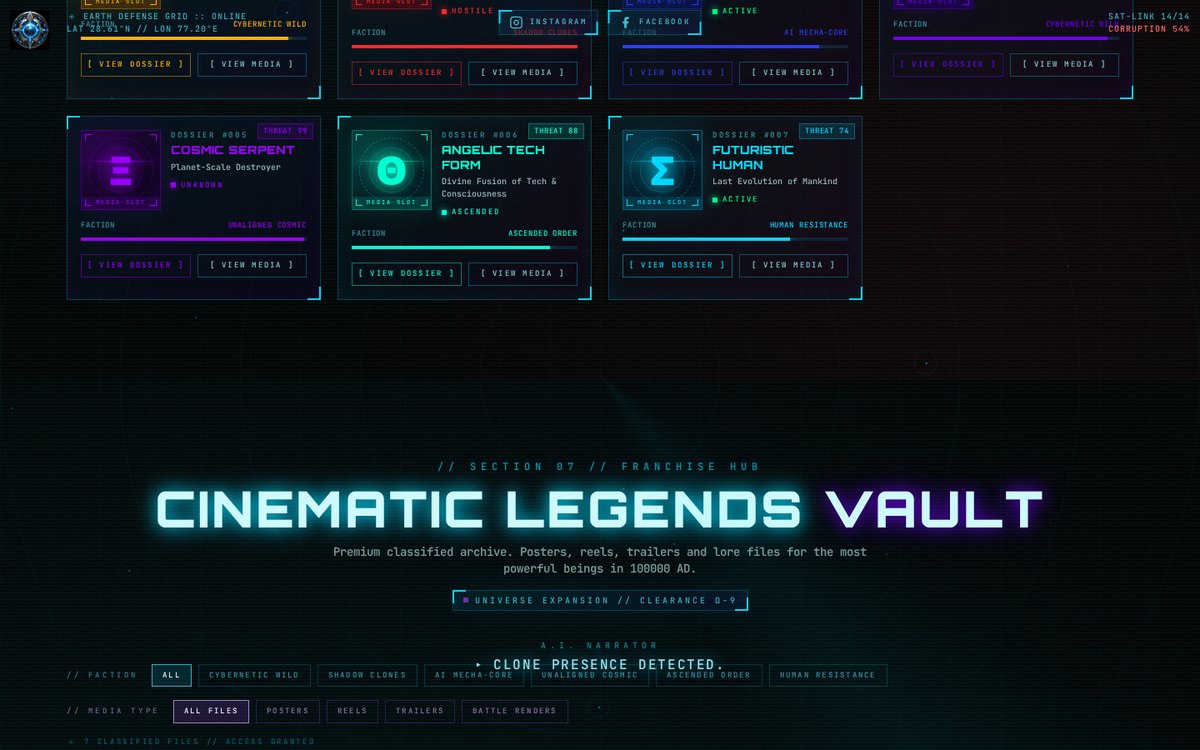
- What you are seeing
- The same characters as a media archive, filterable by faction and by media type — posters, reels, trailers, battle renders.
- Why it matters
- Visitors who came for the art are served without being routed through the lore.
- Problem it solves
- Separates 'show me the visuals' from 'tell me the story'.
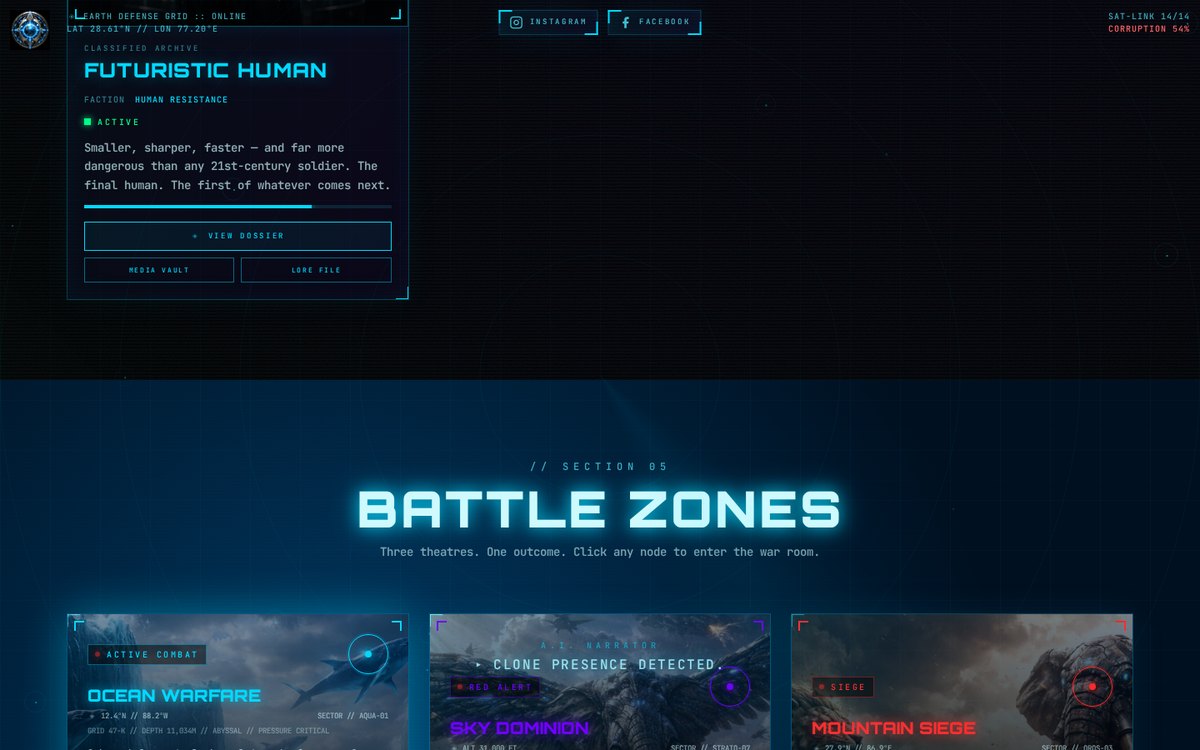
- What you are seeing
- Three theatres — ocean warfare, sky dominion and mountain siege — with coordinates, sector codes and threat, enemy presence and readiness meters.
- Why it matters
- Geography with numbers attached makes a war feel administered rather than described.
- Problem it solves
- Grounds an abstract cosmic conflict in specific places.
- What you are seeing
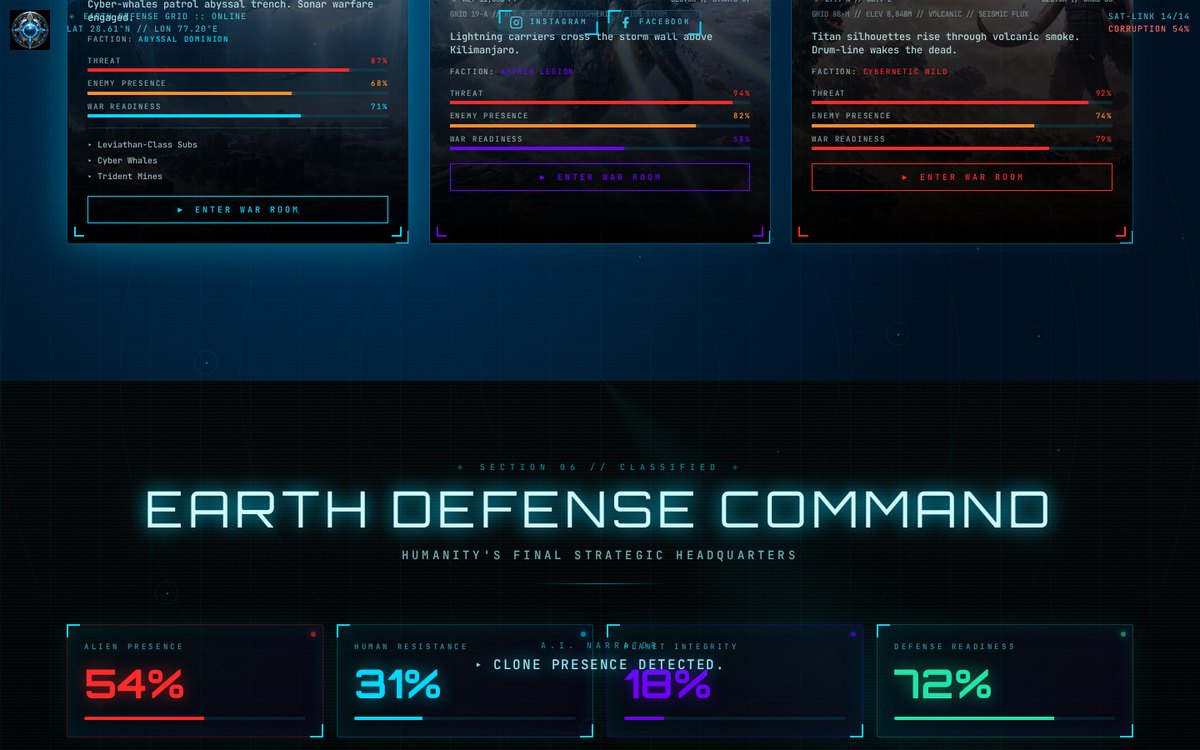
- Four headline states — alien presence, human resistance, planet integrity, defense readiness — beside a live satellite map and an AI command feed.
- Why it matters
- A single dashboard summarises the state of the world so the visitor always knows how bad things are.
- Problem it solves
- Gives the sprawling archive one place that answers 'where do things stand'.
- What you are seeing
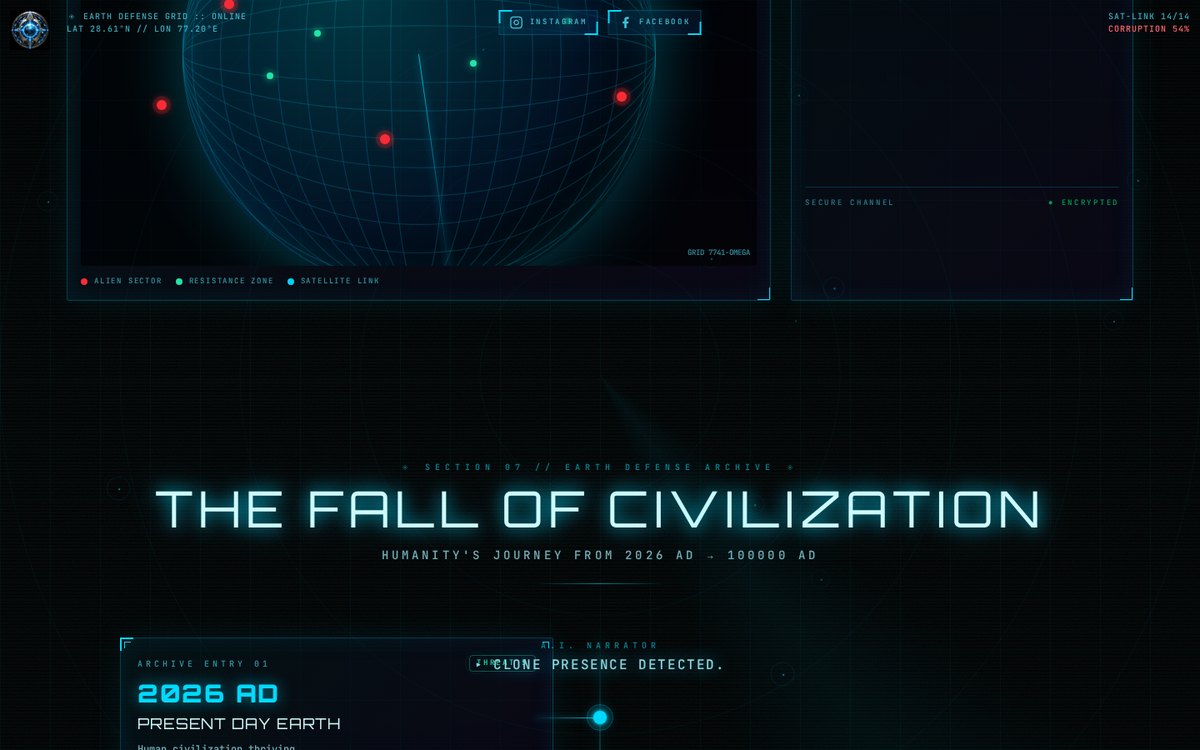
- Ten archive records from 2026 AD to 100000 AD, each with a threat value and an expandable body.
- Why it matters
- Expandable records let the same section serve a ten-second skim and a full read.
- Problem it solves
- Makes a hundred-thousand-year history approachable in one screen.
- What you are seeing
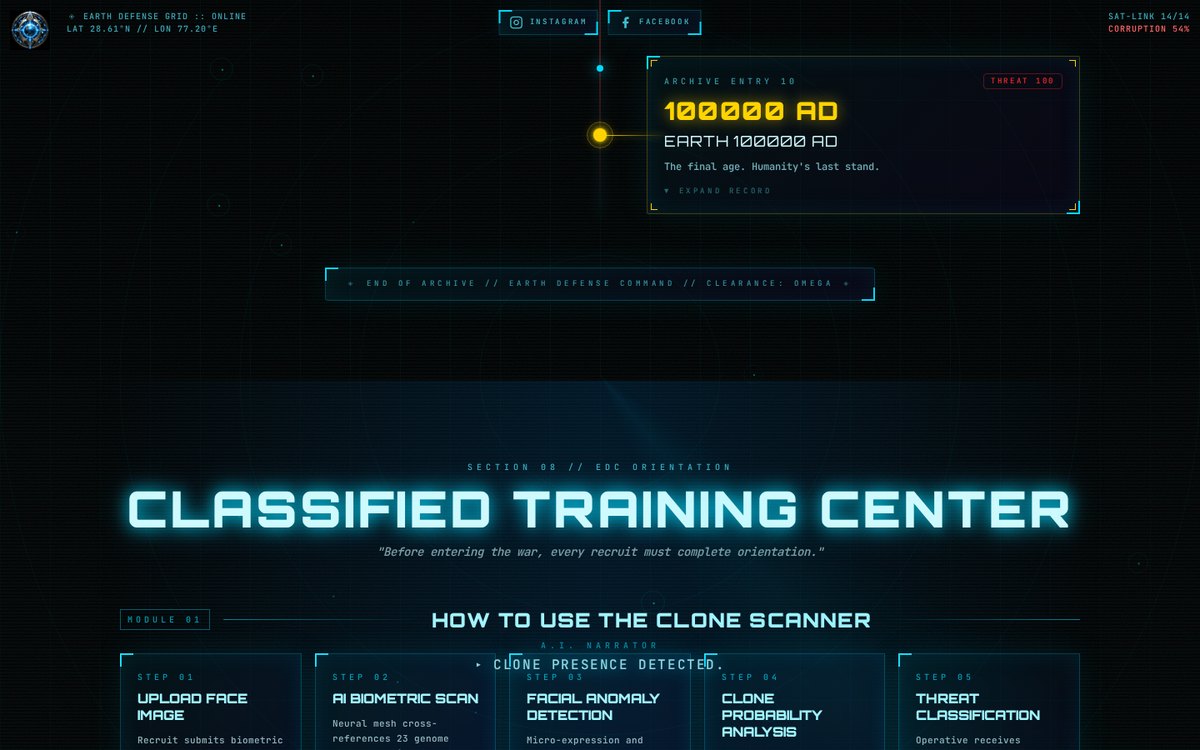
- Module 01, documenting the clone scanner in five labelled steps before the visitor uses it.
- Why it matters
- Explaining an interaction in advance is what earns permission for it.
- Problem it solves
- Turns a potentially uncomfortable camera request into an understood procedure.
- What you are seeing
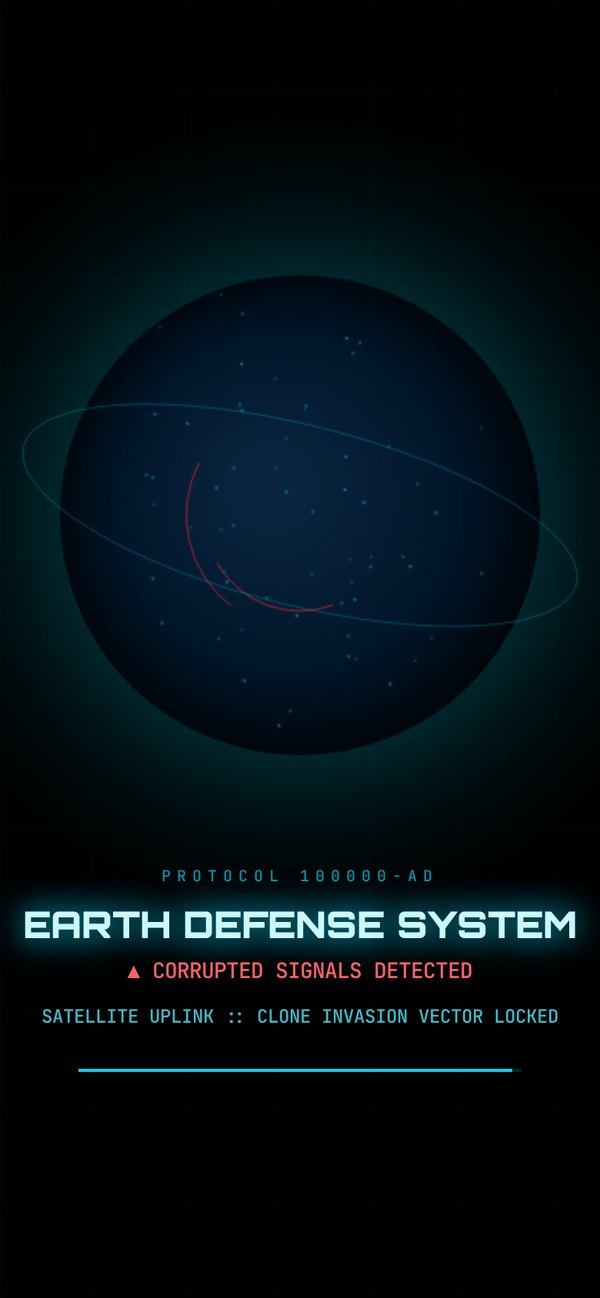
- The defence-grid hero on a 390px screen, with the planet, the system title and the corrupted-signal readout intact.
- Why it matters
- The console conceit has to survive the smallest screen or the whole premise collapses on mobile.
- Problem it solves
- Keeps the full experience available to visitors arriving from social links.
Want work like this for your project?
Trust Me Studio takes on a small number of projects at a time. If this is the standard you're looking for, start a conversation.