REVENUE DOCTOR
An AI-powered website revenue audit and fix platform. Submit a homepage and it scores conversion, trust, search, mobile, performance, messaging and AI-search readiness, prioritises the findings and generates ready-to-use fixes.
- Type
- In-house SaaS product
- Industry
- Website conversion intelligence
- Year
- 2026
- Focus
- Audit → priority → fix
01 — The business problem
Owners know the site underperforms. They don't know why, or what to fix first.
Most website owners can sense that their site underperforms but cannot say what is wrong, which problems matter most or what to change first. Generic audit tools return long technical lists that leave prioritisation and the actual fix to the owner.
Symptoms without a diagnosis
Low enquiries are visible; the weak headline, buried call to action or missing trust proof behind them is not.
Too many findings, no order
Typical audit output is a flat technical list. Without weighting, the hardest part — deciding what matters — is left to the owner.
Diagnosis stops short of the fix
Even a correct finding still needs someone to write the new headline, CTA or meta description. The product had to move from diagnosis to remediation.
02 — From audit to clarity
Turning raw page signals into a report a non-technical owner can act on
Revenue Doctor safely fetches a submitted homepage, extracts observable signals, scores them with a deterministic weighted engine and then uses an AI layer — constrained to those collected facts — to explain the findings and draft concrete copy and metadata fixes.
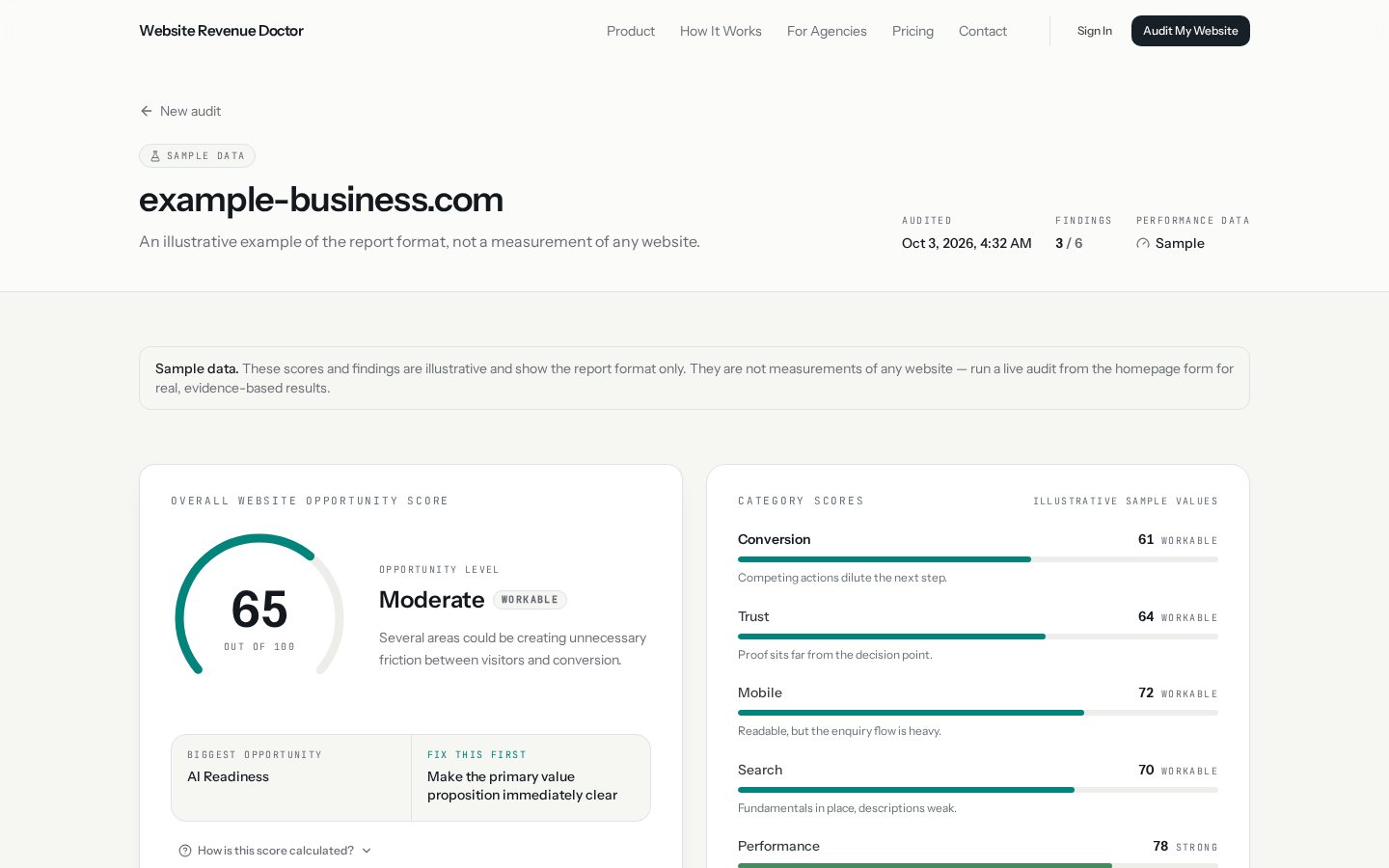
How healthy is my website overall?
A single 0–100 opportunity score with a plain-language level (e.g. Moderate), built from seven weighted category scores.
Where is the biggest problem?
The report names the biggest opportunity and a “fix this first” action directly beneath the score.
Can I trust this number?
“How is this score calculated?” expands the weighted checks behind every category. Scores are deterministic — the same page always produces the same result.
What exactly should I change?
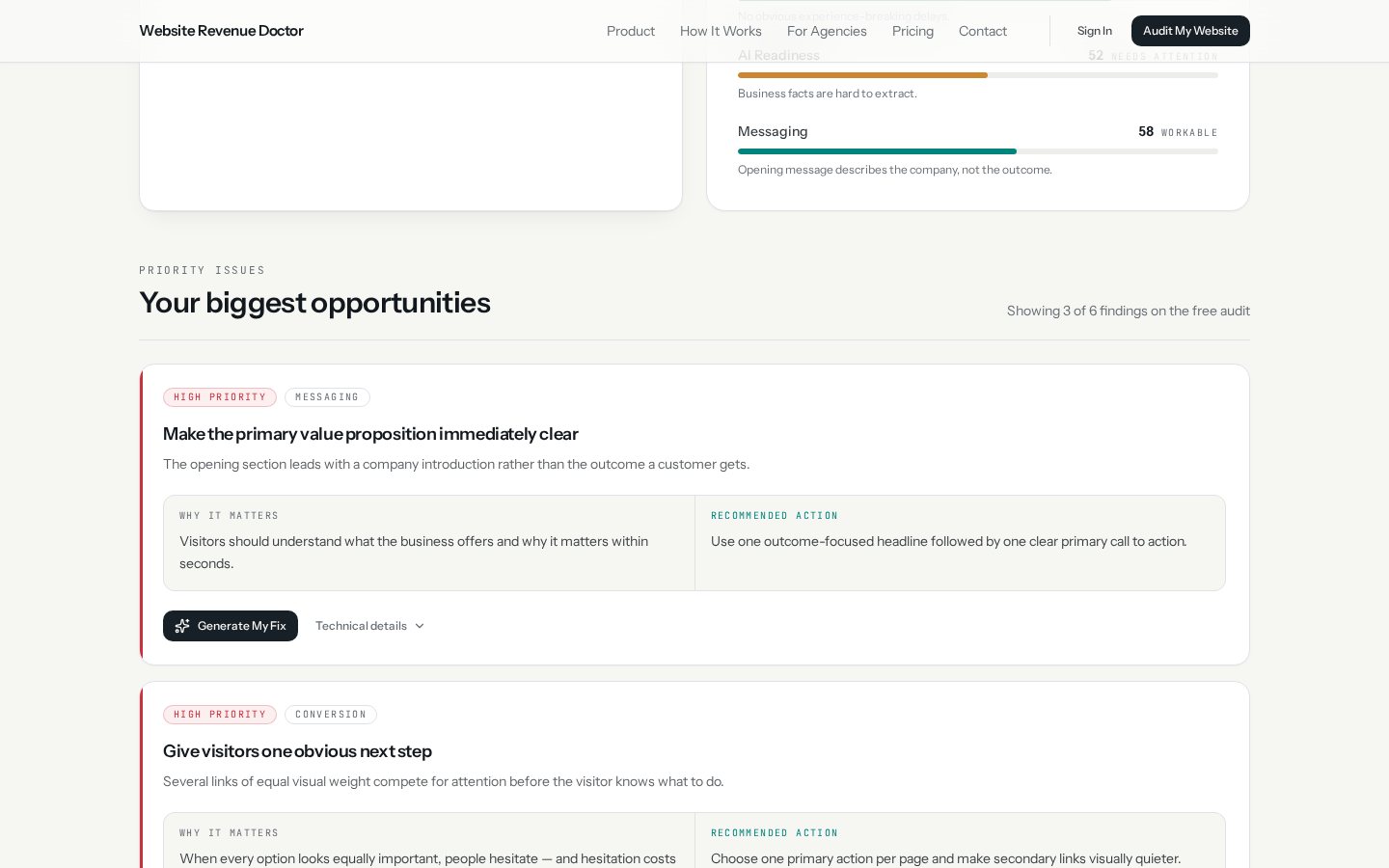
Each finding pairs why it matters with a recommended action, technical details and the evidence observed on the page.
03 — The product journey
One URL in, a prioritised fix plan out
- 1Submit
Enter a website
A domain or full URL is normalised and validated; local and internal addresses are refused before any request is made.
- 2Audit
Fetch, read, measure
The homepage is fetched safely, signals are extracted, JavaScript shells are rendered only when needed and PageSpeed performance is measured.
- 3Prioritise
Scored report
Seven weighted categories, an overall opportunity score and findings ordered by severity, each with evidence and a recommended action.
- 4Fix
Generate the fix
An AI-drafted fix can be generated per finding and copied straight into the site. Signed-in audits are saved to the dashboard history.
04 — AI & decision architecture
The engine owns the facts. The AI only interprets them.
Scoring is fully deterministic. AI is used where language matters — explaining findings and drafting fixes — and is deliberately fenced in so it cannot invent evidence.
- 01
Deterministic scoring before any AI
Each category score is a weighted average of named checks. No randomness and no domain-based mock values, so results are reproducible and explainable.
- 02
Compact, sanitised context as the only AI input
The model receives a length-capped, schema-validated summary — title, meta, headings, CTA text, hero copy, contact options, schema types, trust signals and scores — not the raw page.
- 03
Website content treated as untrusted data
Prompts state that site text is data, never instructions, and forbid inventing evidence, metrics, rankings, revenue figures or testimonials — a defence against prompt injection.
- 04
Structured, validated output
Responses are requested against a JSON schema and re-validated with Zod; malformed output fails safely instead of reaching the user.
Trade-off — Some AI responses are discarded rather than shown, in exchange for predictable output.
- 05
Honest observation quality
When body content cannot be reliably observed (e.g. an unrendered JavaScript shell), body-derived checks are excluded rather than scored as failures, and the model is told the evidence is uncertain.
- 06
Hedged, non-promissory tone
Fixes are written for a non-technical owner in hedged language and never promise sales, rankings or inclusion in any AI assistant.
05 — Findings, priority & remediation
Every finding carries its own reason and its own next step
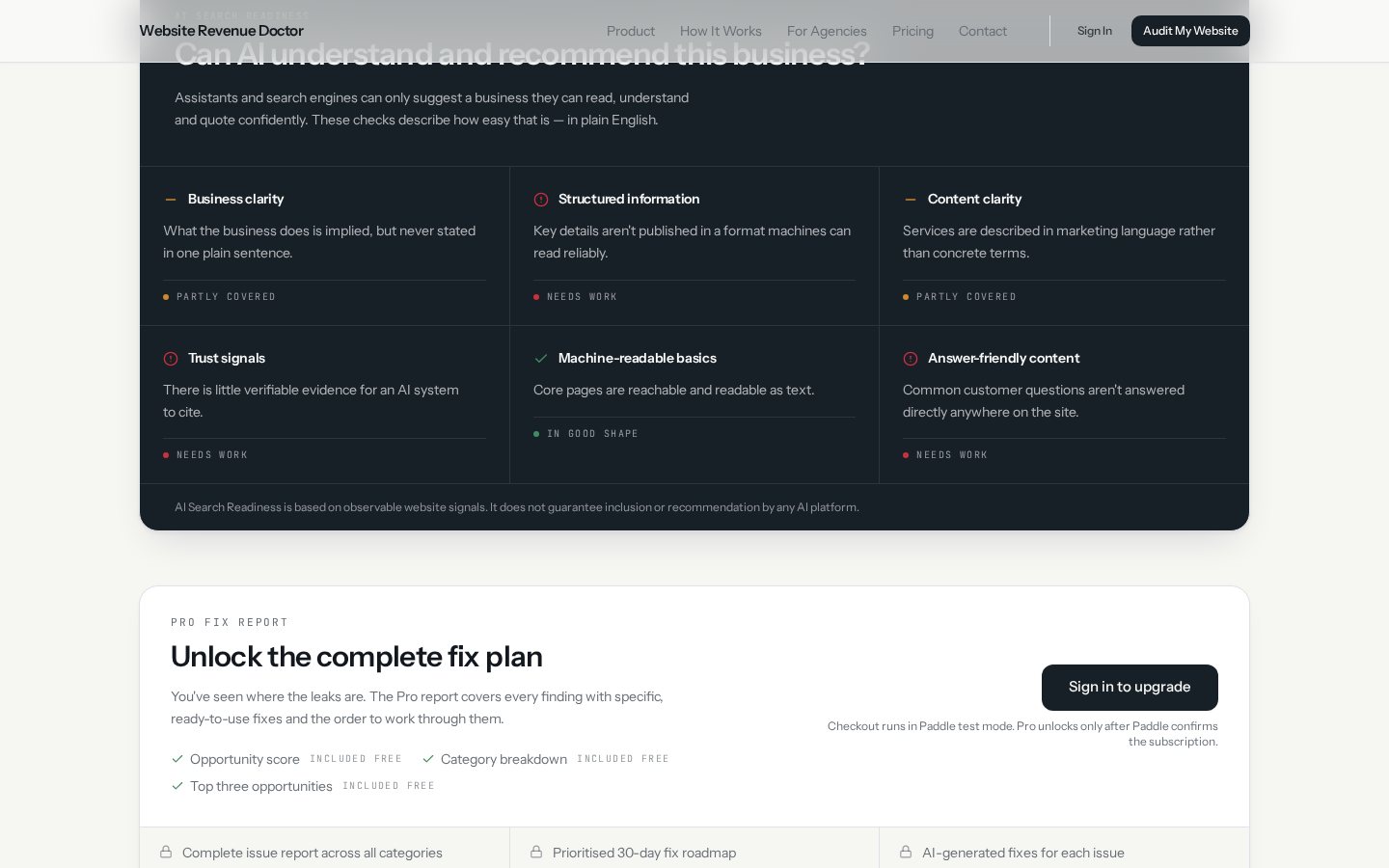
Findings use a shared severity ladder — critical, high, medium, low, passed. The free audit opens the top findings; the rest are clearly marked as part of the full fix plan.
06 — Product & UX decisions
Built to be trusted, not just to impress
Honesty
Sample data is always labelled
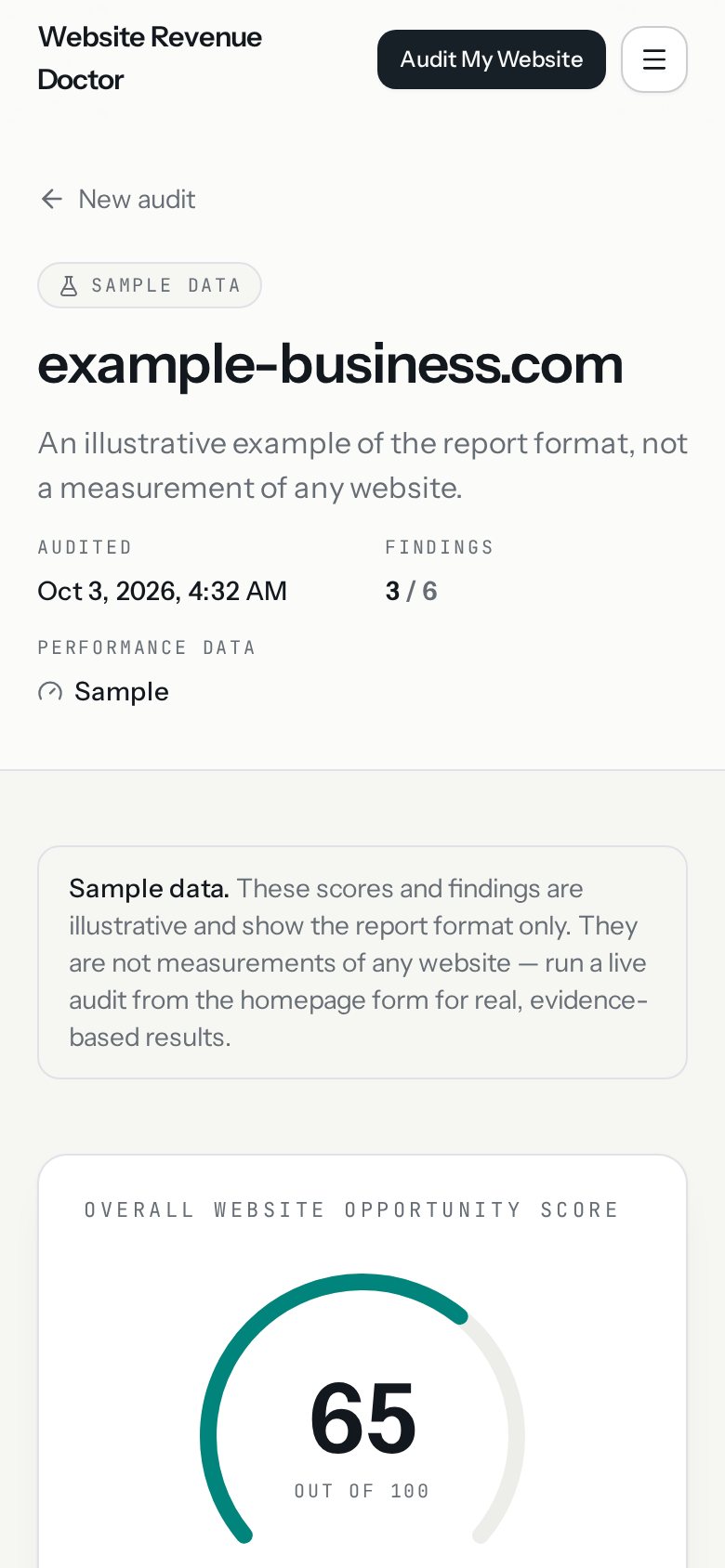
The sample report carries badges, a notice and “illustrative sample values” labels so it can never be mistaken for a real measurement.
Clarity
Score first, explanation one click away
The headline number answers “how bad is it?”; the calculation breakdown is available but never forced on the reader.
Action
Fix next to the finding
Generate My Fix lives on each issue card, so remediation happens in context rather than in a separate tool.
07 — Responsive product experience
A full report that still reads on a phone
Desktop
Score dial and category scores sit side by side; findings use a two-column why-it-matters / recommended-action layout.
Tablet
Panels stack while keeping severity and category tags at the top of each finding.
Mobile
Navigation collapses to a menu, report metadata stacks and the score dial remains the first thing seen.
320px
The report was specifically checked and fixed for overflow at the narrowest supported width.
08 — Technical architecture
A full-stack SaaS running on an edge runtime
Server functions handle audits, AI, usage and billing; the database enforces ownership; external providers sit behind swappable interfaces.
Authentication supports email and Google sign-in; private routes sit behind an authenticated layout. Core logic such as quota reservation and checkout is covered by Vitest tests.
09 — Security & production-minded engineering
Fetching arbitrary URLs safely
- 01
SSRF protection on every hop
http/https only; loopback, private, link-local, CGNAT, cloud-metadata hosts and non-public TLDs are blocked — re-checked on each manually followed redirect.
- 02
Hard request limits
12-second timeout, maximum three redirects, a 2 MB streamed size cap, and only HTML pages are accepted (content type and markup are both checked). The page is read as text and never executed.
- 03
Row Level Security
Profiles, audits, usage and subscriptions are readable only by their owner; anonymous usage records are service-role only, with least-privilege grants.
- 04
Quota reserved before expensive work
Allowance is reserved before any provider call so concurrent requests cannot overspend, then released if the audit fails. Signed-out visitors get a small IP-based allowance with burst protection.
- 05
Verified billing webhooks
Paddle webhooks are checked against the Paddle-Signature HMAC before any data is processed; Pro unlocks only after Paddle confirms the subscription.
- 06
Secrets stay server-side
AI, rendering and payment credentials are read only inside server code; the browser never receives them.
10 — Role & scope
Role & scope
A self-initiated, in-house product built end to end by Divyank Tiwari for Trust Me Studio. No client relationship, customers or commercial traction are claimed.
Product
Audit model, categories, plans and the audit-to-fix flow.
UX & interface
Report hierarchy, finding cards, AI fix preview and responsive layouts.
Engineering
Scoring engine, AI layer, server functions, database and RLS.
Security & QA
SSRF hardening, quota lifecycle, tests and viewport checks.
Deployment
Live at revenuedoctor.gungunova.com.
Commercial status
Core product built; payment activation is being finalised. No customers or revenue are claimed.
11 — Build outcome
What the build demonstrates
A working end-to-end SaaS: live audit, scored report, AI fixes, accounts and saved history
Facts and interpretation deliberately separated — scores are deterministic, AI only explains them
Server-side fetching hardened against SSRF, oversized responses and redirect abuse
Usage reserved before expensive work and released when an audit fails
12 — Product evidence
The live product, screen by screen
- What you are seeing
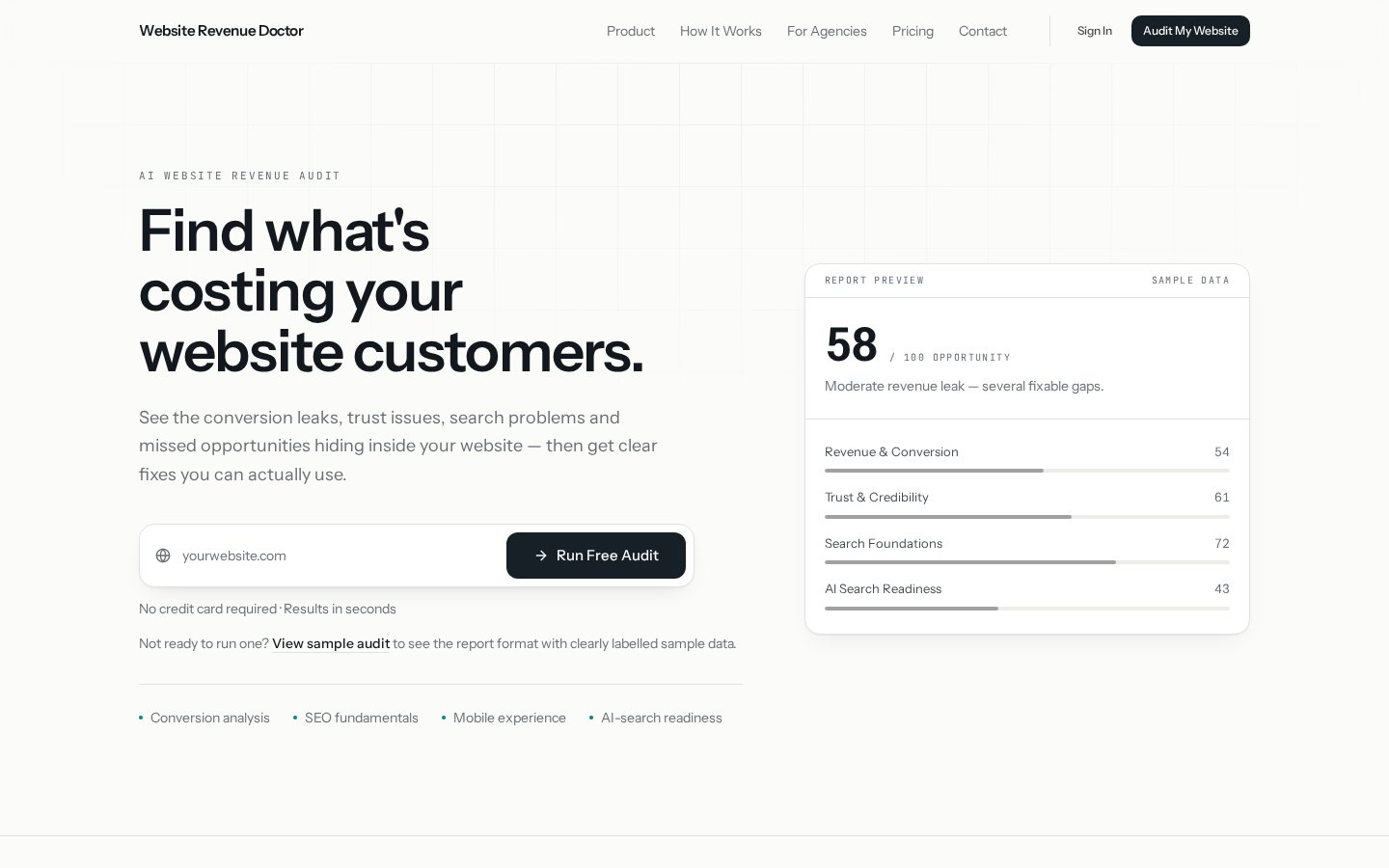
- The public entry point: one URL field, a free audit CTA and a link to a labelled sample report.
- Why it matters
- Starting the audit takes a single input — no setup or account is required for a first result.
- Problem it solves
- Removes the friction between curiosity and a real diagnosis.
- What you are seeing
- Findings ordered by priority, each with category, why it matters and a recommended action.
- Why it matters
- This is where the product earns trust: each conclusion is specific and explained.
- Problem it solves
- Replaces a flat technical list with an ordered plan of what to fix first.
- What you are seeing
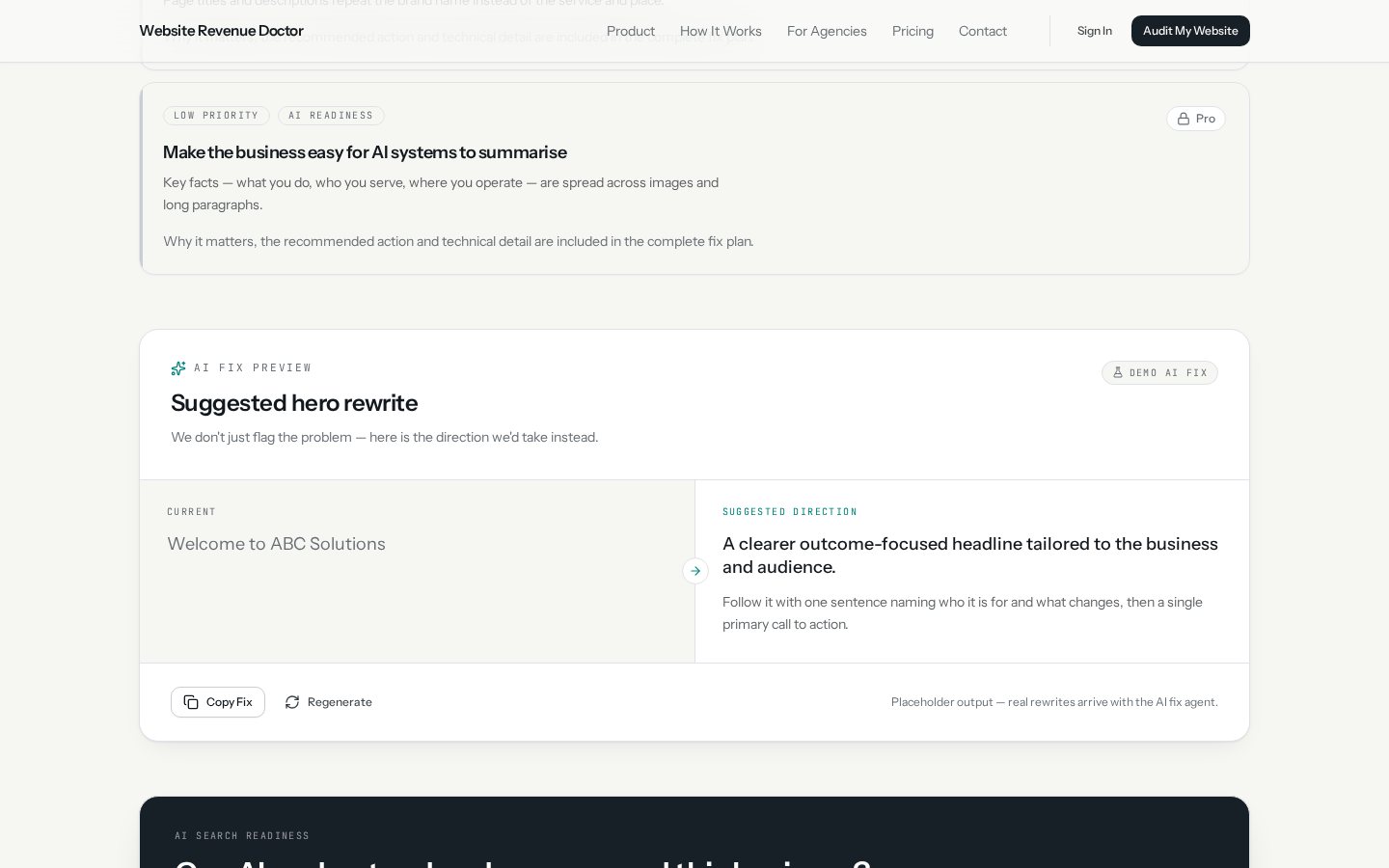
- The fix preview: current copy on the left, suggested direction on the right, with copy and regenerate actions.
- Why it matters
- Moves the product from diagnosis to remediation.
- Problem it solves
- Owners no longer need to write the fix themselves after finding the problem.
Screens showing scores use the product's own clearly labelled sample report, not a measurement of any real website.
Want work like this for your project?
Trust Me Studio takes on a small number of projects at a time. If this is the standard you're looking for, start a conversation.