LEADRESCUE AI
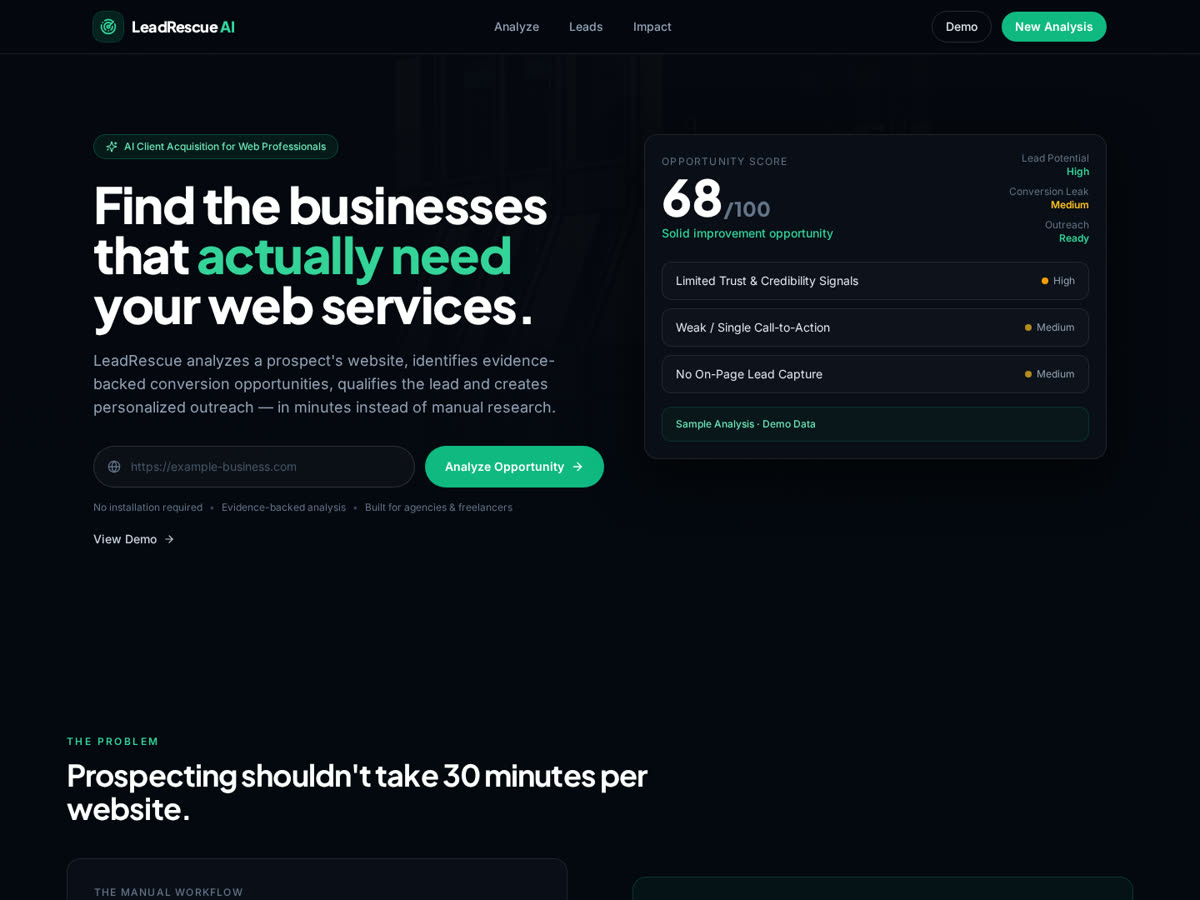
An AI-assisted lead recovery product designed to identify businesses losing opportunities through weak web conversion paths and turn those findings into actionable sales intelligence.
- Type
- Trust Me Studio product build
- Industry
- AI Product Build
- Year
- 2026
- Focus
- Lead leakage
01 — The business problem
Traffic arrives, the opportunity leaks, nobody sees it happen
Businesses can receive web traffic while still losing potential opportunities because of weak conversion paths, unclear calls to action or missing lead capture. For agencies and freelancers, finding and evidencing those gaps is slow manual research.
Leakage is invisible by nature
A weak call to action, a missing capture point or an unclear next step produces no record. The business only sees that enquiries are low, never where they were lost.
Diagnosis is slow manual work
For an agency or freelancer, evidencing those gaps means reading each prospect's site by hand — which is why prospecting usually runs on assumption instead of evidence.
The design consequence
The product had to convert a vague suspicion into discrete, named findings that can be shown to the business owner and prioritised against other prospects.
02 — Visitor psychology
What stops someone acting on an AI finding
An automated verdict is only useful if the person reading it can defend it to someone else. The interface is built around the objections that arrive the moment a score appears on screen.
Where did this conclusion come from?
Each issue is surfaced individually against the analysed site rather than folded into one number, so a finding can be checked against the page it refers to.
Which of these actually matters?
Findings carry a severity level, because a list without weighting hands the prioritisation problem straight back to the user.
Which prospect do I work on first?
Findings are consolidated into a single opportunity score, so a set of analysed businesses becomes a ranked queue rather than a folder of reports.
What do I say to them?
Outreach material is generated from the specific issues detected, so the conversation opens with the evidence rather than a generic pitch.
03 — User journey
From a URL to a conversation worth having
LeadRescue analyses a submitted website, surfaces evidence-backed conversion issues, scores the opportunity and prepares supporting outreach material, so prospecting produces a qualified, explainable finding rather than a hunch.
- 1Submit
A real site, not a checklist
The prospect's live URL is the input, so the assessment describes what exists rather than what is typical.
- 2Interpret
Findings with severity
Conversion weaknesses are named one at a time and weighted, which is what makes them arguable rather than assertive.
- 3Prioritise
One opportunity score
Individual findings resolve into a ranking signal so effort goes where the recoverable opportunity is largest.
- 4Act
Evidence-led outreach
The findings become the outreach content, keeping the first contact specific to that business.
04 — Design decisions
Why this information appears first
Primary
Opportunity score
The first thing shown, because the user's real question is not what is wrong but whether this prospect is worth an hour of their day.
Secondary
Individual findings
Placed directly beneath the score so the number can be opened and examined instead of taken on trust.
Tertiary
Outreach material
Positioned at the end of the flow — it is the output of a decision already made, not an input to it.
05 — Decisions & tradeoffs
Choices made for credibility, and their cost
- 01
Keep AI interpretation auditable
Findings are presented as separate, inspectable items rather than a single opaque verdict, because a conclusion the user cannot trace is a conclusion they cannot repeat to a prospect.
Trade-off — A longer results view than a single headline score would need.
- 02
Score for prioritisation, not for judgement
The score exists to order a working list. Framing it as a quality grade would invite argument about the number instead of action on the findings.
Trade-off — The score is only meaningful in comparison across prospects, not in isolation.
- 03
Organise analysed businesses into a working list
Prospecting is a repeated activity. One-off reports lose their value the moment the tab closes; a list keeps the analysis in the workflow.
Trade-off — More product surface to maintain than a single-page analyser.
- 04
Tie outreach to detected issues
Specificity is the entire advantage. Generic outreach performs no better with an AI tool behind it than without one.
Trade-off — Outreach quality depends directly on the quality of detection.
06 — Role & contribution
Role & contribution
A self-initiated Trust Me Studio product build — not commissioned client work. It has no claimed customers, revenue or recovery results.
Product definition
The analyse, qualify and outreach loop.
UX design
Analysis input, findings presentation and lead workflow.
Interface design
Scoring and severity hierarchy.
Frontend build
Responsive implementation of the working build.
Launch
Deployment of the working build.
Commercial claims
Self-initiated build. No customers, revenue or recovered-lead results are claimed.
07 — Responsive behaviour
A working tool, not a desktop-only dashboard
1440px
Score, findings and lead list are visible together, so prioritisation and evidence stay in one view.
1024px
The lead list yields space to the findings panel; severity remains the strongest signal on screen.
768px
Single column ordered score, findings, outreach — the sequence in which the decision is made.
390px
Findings become stacked cards rather than a compressed table, keeping severity readable at a glance.
08 — Outcome
What the build demonstrates
Conversion weaknesses expressed as discrete, explainable findings
A prioritisation model that turns analysis into a working list
An AI-assisted workflow designed to stay auditable rather than opaque
This is a self-initiated build. No customers, revenue, recovered leads or accuracy figures are claimed.
09 — Project gallery
The working build, and what each screen is doing
- What you are seeing
- The analysis surface of the working build: a submitted site, the conversion issues detected on it, and the consolidated opportunity signal.
- Why it matters
- This screen decides whether the tool is used twice. If the findings cannot be traced back to the analysed page, the user cannot repeat them to a prospect.
- Problem it solves
- It turns a suspicion that a business is losing enquiries into named, weighted findings that can be prioritised and evidenced in a conversation.
Want work like this for your project?
Trust Me Studio takes on a small number of projects at a time. If this is the standard you're looking for, start a conversation.